
The Nation State and the Promised Land: An American Yiddish Writer in Israel, 1949, by Solomon Simon. English translation, 2024, by David R. Forman. All rights reserved.
Page numbers. from Medines Yisroel un Erets Yisroel, 1950, Farlag Matones (NY), are included for those who wish to follow along with the original Yiddish, below.
To begin with the Introduction, click here.
Who would have believed what we have heard? – (Isaiah 53:1)
p. 9
In three days I will travel to… I don’t know whether I am traveling to Erets Yisroyl, the Land of Israel, or to Medines Yisroyl, the State of Israel.
I, an inhabitant of New York, lived in the Land of Israel for the first fifty years of my life. As for my birth, I was born in a small Litvish shtetl[1], and that’s where I actually resided. But I lived, like all Jewish children, in the Land of Israel. I dwelt there, one of the Jews of Judah, and every mountain and valley was familiar, near and dear to me.
Of course, I mixed all the generations together. The tents of the patriarchs—Abraham, Isaac and Jacob—stood right next to the Ivory Palace that Ahab built in Samaria. Beth-El, Beersheba, Lod, Hebron and Yavne were all one city to me. Isaac contended with Abimelech over the fountains at one end of the city, and Rabbi Akiva taught Torah to his twenty-four thousand students at the other end of the city.
But I knew Father Abraham and Mother Sarah personally; I saw Father Jacob meet the beautiful young Mother Rachel for the first time with my own eyes. I spoke to Rabbi Yohanan Ben-Zakai face to face, I knew what color beard Rabbi Joshua Ben Henaniah had, and I would have recognized the compiler of the Mishnah, Rabeynu Hakoydesh, if I saw him walking down the street.
p. 10
When the First Temple was destroyed, I was driven out with the refugees. I remember it as though it was yesterday: Jeremiah walked, shackled in chains, carrying the scrolls of the Five Books of Moses along with the speeches of Isaiah, Amos and Hosea, wrapped in Egyptian papyrus in a small pack tied onto his shoulders. I can see the downcast refugees even now, crying and praying towards Mother Rachel’s grave. I hear Jeremiah’s voice with my own ears, comforting the Jews and telling them that Mother Rachel is praying for them, and that God has heard her prayers:
So said God:
Restrain your voice from crying
And your eyes from shedding tears,
Your efforts for your children will be rewarded.
They will return from the enemy’s land.
There is hope for the remnant:
They will return to the borders of their land
And the refugees will be returned.
And I returned with them from Babylon.
For months, we dragged ourselves. I remember it clearly: How we stopped when we reached the border of the Land of Israel. A tall man, dressed in a Persian uniform called out: Jews, be ready! Now we are crossing the border of the Holy Land! Suddenly, a song was heard. A small, thin little Jew with a snow-white beard and dark hair sang out in a strangely high voice:
When God overturns the captivity of Zion,
Truly we are in a dream…
Great things he has done for us!
Great things he has done for us!
The tune was sweet and melodious. A few individuals took up the melody at first, then soon nearly the whole company joined in.
But an old Jew sitting next to me grumbled:
“Great things! What great things? God himself ought to have
p. 11
redeemed us, and look, we are here through the kindness of a gentile, an idolator—Cyrus, a heathen!”
But only a few old people voiced any discontent. Everyone was intoxicated with joy: We were returning to establish God’s Kingdom. All of Jeremiah’s and Ezekiel’s prophecies would come true, and the speeches of the new exile-prophet, the great comforter, would be made real…
I see the land before me now. This time I have not had the merit to be one of the Yesud Hamala, the founding settlers of the land. Three times I have been one of the crowd. I remember the Aliya[2] of Father Abraham as though from a dream. I was one of his followers. It was so long ago that what remains is no more than a shadow of a shadow of a trace memory. I remember a little more of the Aliya with Joshua. I remember the Yesud Hamala, the return from Babylon with Ezra, quite clearly. The holiness with which the Jews returned from exile was plain to see. I witnessed how they left their worldly possessions, left their property and respected positions behind in exile in order to build God’s Kingdom.
Jews were in exile only a short time, but in that short time they made parts of that foreign culture their own. They knew Hebrew, but they spoke Aramaic and wrote Hebrew with Aramaic letters. They knew Hebrew because God’s word was spoken in that language. But they did not hurry to root out the foreign tongue, which had become their own. The main point, after all, was God’s Kingdom, which had been dreamed up in Babylon. When the rule of holiness was established, then they would decide what to do with the foreign spiritual possessions they had taken on. In the meantime, nothing needed to be thrown away.
Now I am traveling to see that land. What will I find there? Erets Yisroyl, which is continuity, or an Israel that is merely a nation state? Will I see a new Aliya there, an addition to those three Aliyas, or just another government? Have the new pilgrims come to establish a new Kingdom of Heaven, or have they come to the Land of Israel because they no longer want to be an exceptional people,
p. 12
…because they have grown tired of carrying the yoke and want to become a nation like all other nations?
My heart trembles. Will I find the spirit of A. D. Gordon there, who had the courage to make a break from his own life, and wanted to renew the old Yiddishkayt; which had transformed work into holiness, and had transformed holiness into everyday life? Or will I find the “new Jew” who, having suffered at the hands of the goyisher rifle, has taken a rifle in his own hand and wants to teach the goy a lesson.
I don’t know, I don’t know.
**
*
Here I go, I’m flying. I don’t like the whole business of traveling by airplane. You go in, you sit yourself down and they close the door behind you. You sit and you fly. You neither see nor hear anything, other than the roaring of the engine. The plane is large, but it is packed so full that you cannot move. It is hard to have a conversation with your fellow passengers. Strolling is even harder. The light from the little window of the neighboring seat pierces your eyes if you try to read or doze. Luckily, the flight will not be too long—altogether six-and-a-half hours flying time.
We left Rome at four in the morning. In six hours we would be in the State of Israel. Nobody closed an eye. A strange restlessness came over everyone.
We were approaching the Land of Israel. A song began in the back row. Soon the whole airplane was singing. Suddenly, someone began reading verses from Isaiah [60:4]:
Lift up your eyes all around and see,
they all have gathered,
your sons come to you from afar,
and your small children carried in your hands
What kinds of ships are these that fly like a cloud
and like doves to their cotes?
I closed my eyes, and my heart shook: These verses were spoken to us, to us who were flying now to the…
p. 13
… State of Israel! In the plane sat Jews from all over the world: Jews from Europe, from all of the Americas; there was even a Jew all the way from Bogota, Colombia.
Someone protested.
“You’re reading the passage wrong. The word ‘ship’ is not in there.”
The reader answered him.
“Look at the commentaries again. That is the correct interpretation.”
I sat with my eyes still closed and it was crystal clear to me that the prophet meant us. The airplane flew like a cloud; little children were sitting in their parents’ arms; a lively little boy named Joel clapped his hands: “Soon, soon we will be in Jerusalem!”
I saw land! Why were the minutes dragging so slowly? Why was it taking so long to land? Why was the pilot just sitting there?
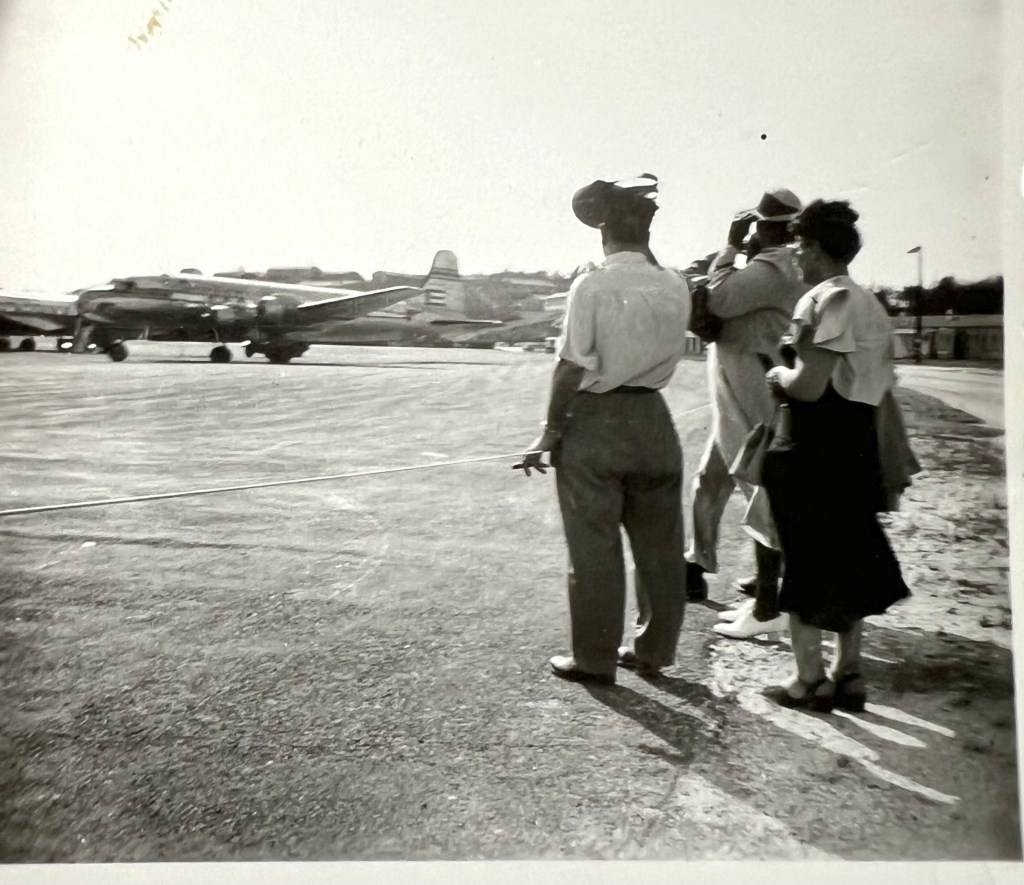
Yes! The plane stopped, the door opened, and we were out.
Two officers in uniform greeted us:
“Shalom, Jews, Welcome!”
I lifted up my eyes. The blue and white flag fluttered over the airfield. On the officers’ sleeves the words Military Police were written in Hebrew.
Yes, it’s true! It’s actually a Jewish state! The four rabbis in our group recited the Shehekhiyonu blessing in the name of God’s reign over the world. It distressed me not to have prayed for so many years.
Relatives were waiting for the passengers. They waved. We waved back with handkerchiefs. You could hear their cries:
Yankl! Dovid! Shloyme!
We began pressing into a fenced-in area. Four policemen told us where to go. The police with the stripes on their sleeves said, in a good-natured, Lithuanian Yiddish:
“People, don’t push! It won’t help, anyway. Your relatives will have to stand there and wait.”
We were led to where our passports were reviewed. Several among us spoke a fine Hebrew. The officials answered them in Hebrew. I spoke
p. 14
…to them in Yiddish. I was answered in Yiddish. They spoke the language naturally and unhaltingly.
The officers were not strict. There was no trace of “kazna”[3]. It was not a demeanor of schooled courtesy, but the conduct of genuine and down-to-earth human beings.
It was very interesting when it came to paying duty. My wife and I spread out our seven valises on the long table. A smiling, good-humored young man asked openly:
“Did you bring things that have a duty on them?”
I answered:
“I have brought tobacco (I am a heavy smoker) and silver utensils—a present for my sister-in-law and brother.”
“There are high taxes on those things.”
“It can’t be helped,” I answered. “If it is worth it to pay, I’ll pay. Otherwise, I will leave it behind with you.”
I took out the silverware and the tobacco. He looked at my tobacco.
“A box of cigars and two pounds of tobacco. And where are you pipes?”
I understood the broad hint. I took out my two pipes. He looked them over.
“Those are fine pipes! You can bring the tobacco with you, but I have to consult about the silver.”
He called over a higher official. This one looked examined the silver. He said:
“Very nice! You took your own complete set of silver and brought it for your brother as a present. A fine present indeed! I wish I had such a brother! Go, and may he use it in good health!”
Changing currency was difficult. The room was tight, the table, small and narrow. There was just one person sitting there doing the calculations. The crowd joked:
“The Israeli government might consider not keeping its bank in a little wooden box.”
The agent took their joking to heart, and answered earnestly:
p. 15
“A year from now, come see what our bank will be like. We’ll be spread over four rooms and have nice soft armchairs for you to sit in. Girls will bang on typewriters and there will be a big calculating machine in the middle of the room. What do you think, we’re going to stay in this hole?”
“Amen!” everyone answered.
My brother was waiting for us with a taxi. We got in and went to Ra’anana. My brother spoke to me, but I didn’t hear him. It seemed to me my sister-in-law was crying: Finally here, after so many years of waiting! But only part of me heard. My ears were still ringing:
“Shalom, Jews! Welcome!”
I could still see the Yiddish-speaking officers.
“We’re in Yidn-Land[4]! In Yidn-Land! You are here, seeing the Promised Land with your own eyes!” called a voice inside me.
Who would have believed what we have heard?
To continue with Chapter 2, click here.
Here is the Yiddish text of chapter 1:
[1] Simon was born in Kalinkovitch, in Belarus, then part of the Russian Empire. A shtetl is a small town. By calling it ‘Litvish’ or ‘Lithuanian’, he identifies himself as a ‘Litvak’ — someone who speaks a Northeastern dialect of the Yiddish language and holds certain correlated attitudes. This cultural designation was more relevant to the Jews of the time than national borders.
[2] The Hebrew word Aliya, which means ‘immigration to Israel’ also means ‘being called up to [read from] the Torah’ during a religious service.
[3] Kazna. Russian for ‘exchequer’ or ‘treasury’. Simon may mean officials who try to grease their own palms, or are otherwise confiscatory, or he may be indicating arrogance.
[4] Yidn [yee-dn] means ‘Jews’ and Land can mean either ‘country’ or ‘land’. But neither Jew Country, nor The Land of the Jews, has the warmth or directness of Yidn-Land, so I’ve kept the original Yiddish.
 The Nation State and the Promised Land