
The Nation State and the Promised Land: An American Yiddish Writer in Israel, 1949, by Solomon Simon. English translation, 2024, by David R. Forman. All rights reserved.
Page numbers from Medines Yisroel un Erets Yisroel, 1950, Farlag Matones (NY), are included for those who wish to follow along with the original Yiddish, below.
To begin with the Introduction, click here.
There are words in every language that are always loaded with emotion and imagery; words that never get worn out; words that do not become clichés. In Yiddish, “Jerusalem” is such a word.
All Jewish children who have immersed themselves in Torah, studied in a Yeshiva, or even just gone to kheyder know Jerusalem. There is a picture of the city in the imagination of every Jewish person. Naturally, this picture has been built out of scripture verses, passages of Talmud and snippets of folklore—a mix of reality and fantasy, of the distant past and the actual present.
We went to see Jerusalem. When we got to the central bus station in Tel-Aviv and I saw the sign reading ‘Jerusalem,’ my heart skipped a beat. When the bus pulled up with the word ‘Jerusalem’ in its little window, it still seemed to me as though it must just be an illustration in a storybook. Even as I sat down in the bus, I did not believe that my family and I were actually riding to Jerusalem:
I am writing a children’s book, I thought, with a story about Jews who are riding to Jerusalem.
The bus went on the road to Jerusalem. The countryside was desolate, overgrown with dried grasses and thorns. It matched how…
p.62
I pictured it in my mind: Jerusalem and wasteland. A bit of a sentence crept into my thoughts and I could not get rid of it:
“Every city stands on its spot, and Jerusalem is desolate.”
A soldier sat next to me. Before I could look around, he spoke to me as though to an old acquaintance, and like all the Jews in the country, he had not yet recovered from the great victory. Every five or ten minutes he would point with his finger:
“You see, this place here was impassable. The scoundrels were in charge here. But now , the driver can not only drive here, he can even blow the horn as much as he wants. He does not have to worry about waking up an Arab who is hiding somewhere, lying in wait with a loaded rifle.”
We were getting closer to Jerusalem. I already supposedly knew about the gruesome siege, and about the deadly peril that the drivers of the transports faced when they tore through the hail of bullets and fire the Arabs let loose on them from the mountains. Still the images I saw made me very uneasy, along with the soldier’s conversation:
“You see all these overturned lorries (trucks)? Every vehicle was driven by someone who knew how dangerous the road to Jerusalem was. But ammunition and food had to be brought to the besieged. The destroyed trucks lie here like witnesses to what the Arabs did to us.
“The trucks were blown to pieces by machine guns and often by mines. The devils were in fortifications on the hills on both sides of the road. It was a real piece of work to tear them out of there. You can see, there is a dead truck practically every two-hundred meters. People wanted to clear them out and make the road look nice. But then they thought better of it. Let them lie. The dead vehicles should stay as a memorial. People should see how hemmed in we were by the enemy. Then they will understand the bravery of the Yishuv.”
We turned off the main road. A piece of the road was still held by the Arabs, so the bus used the…
p. 63
newly-built highway. The road had been built hastily, and there were holes here and there, where the asphalt had washed out. Groups of workers stood there, working. On both sides of this new road, “The Burma Road”, the landscape was even more barren and desolate. There was no grass and no trees. Involuntarily, a verse came to my tongue:
The roads from Zion are sad without those who come for the festivals. All her gates are deserted. [Lamentations 1:4]
Now we were back up on the old road. The hills kept coming higher and higher, until they surrounded us. The mountains pushed up through the landscape all the way up to the sky. Barren, dry rock. Here and there was a bush or a small tree and, even less often, a patch of grass. That made the barrenness even more dramatic.
It might have just seemed that way, but I saw signs of terraces on the lower parts of the hills. In the time before the destruction of the Second Temple, the foothills were fertile. Every mountain had terraces, and people sowed and planted on them. But, over the course of hundreds of years, the rains washed off the fertile soil and the terraces, and only rocky mountain slopes remained. Yet grass sprouts here and there among the cracks in the rocks, a dwarf tree grows and a bush clings to the stony ground with its long, narrow roots.
A kind of distress and anger took hold of me. The earth does look fertile. The earth near the foothills is dark red, like all fertile places. (This is why earth is ‘adamah’ in Hebrew. ‘Adam’ means red). When the earth is sown and watered, the fields are green with full and broad-leaved vegetables. Where Jews have planted forests, the trees are fresh and shady. But so little has been planted, sowed and watered. The whole region looks dried out and sunburnt, barren and empty.
We came to the Arab villages that were taken by the Jews. The walls of the buildings that stood next to the road were smeared with the signatures of soldiers from the division that took the village, or guarded it. The soldier sitting next to me kept…
p. 64
telling the story of every battle and every village, whether destroyed or still standing.
The bus went up and up the mountains. It started banging and wheezing so loudly that the soldier could no longer talk. It grew cooler and cooler. We had to put on jackets. The bus crawled out from a twisty road and rattled up onto a flat bit of land. In the distance, I saw Jerusalem, laid out like a picture on a painted postcard.
A modern man riding on a bus cannot fall to the ground and lose himself in ecstasy when he comes to the gates of Jerusalem. So I sat, as if peacefully, and was silent. I watched the city unfold before me and did not know what to do with myself.
We rode into New Jerusalem[1]. On the surface it was a city like all cities in Israel. But I felt as though there was something different. Even in the central bus terminal, I already saw different-looking Jews than in Tel-Aviv. Jews with beards, peyes, and long kapotes [frock coats]. More Yiddish was spoken than Hebrew. Something about the city looked more Jewish to me than Tel-Aviv. Why? I don’t know. Maybe it just seemed that way to me because I knew I was in Jerusalem. Still, I felt it at every turn. The restaurant food was more Jewish than in other places in Israel. The restaurateur did not look like other Jews of his age, as though he might as easily live in New York and speak English, or in France and speak French, but he was a kind of continuation of Vilna, Warsaw and Minsk. A Jew who bore not only the yoke of Yiddishkayt, but also the cleverness, experiences and pride of many generations of Torah.
We stayed in a truly fine hotel. The prices were set by the government. A large poster on the wall tallied every little detail that a hotel can charge, with the price next to each item on the list. The hotel was sumptuous, but at the registration desk there stood a man who spoke a poor English, good Yiddish, and a Hebrew with an accent from our loshn-koydesh.[2] The man carried something of the specific flavor of a Jewish wayside inn.
p. 65
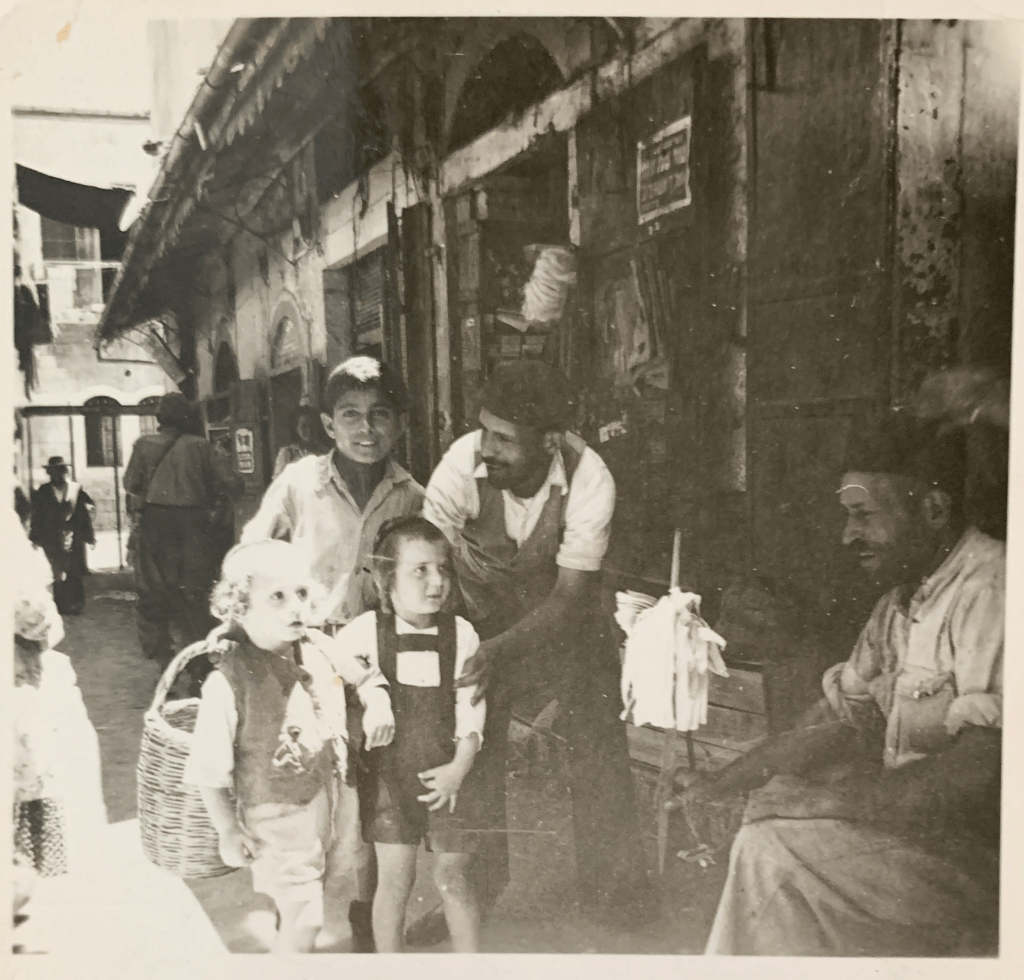
It was Friday, still before noon, and we set off for the “Mea Shearim” quarter. It’s not a big neighborhood, but its streets are twisted and tangled, with probably a hundred entrances and exits. We walked there as a group of four: My wife, my daughter, a relative of ours, and I. Two French Jews joined us a little later and went along with us.
The streets of New Jerusalem are broad, and nice and clean. Suddenly, we happened into an Eastern quarter with narrow streets; courtyards within courtyards, houses on top of houses with balconies in the air, steps and doorways. And there was commotion, chaos and stench, and a tangle of men, women, children and donkeys.
Women carried tins of baked goods and pots of cooked food. Men ran to the baths with laundry under their arms. There were tiny stores, two cubits long by one cubit wide with half-empty shelves. Cries carried from the houses:
“Motl, where are you? Yankl, why aren’t you going with Tateh to the public bath?”
Here was a store with challahs and other baked goods, in a cloud of flies. A young woman with a kerchief drawn down to her eyes stood weighing a challah in her hand. She laid it down and picked up another. She tapped and weighed every challah in the bin like that until she picked the first one back up again.
A Jew wandered by from somewhere. He held a cloth full of fruit in one hand and a large braided challah for Shabbes in the other. Under his armpit, a bottle of wine.
We came to a greengrocer. There were flies and all kinds of gnats. The fruits and vegetables were fairly rotten and lay uncovered in big piles on the ground, on carts and on boards.
A young couple, apparently Yemeni, came in and had them weigh a kilo of grapes, two kilos of tomatoes and some vegetables—not picking them out, not even rejecting any of the cucumbers that broke in their hands. Put it all in a bag and were done. The bag quickly got wet and turned all kinds of colors.
My lady grew incensed:
p. 66
“Here’s your Yiddishkayt for you! Unembellished, unadorned, and undiluted. Pure Yiddishkayt! A piece of the shtetl, taken straight out of the writings of Mendele and S. Ben Zion![3] Be proud!”
Meanwhile, the French Jew noticed a dignified-looking old man, sitting in a cellar and working on something. When he pointed his camera at the cellar, the Jew screamed:
“Go away, heretic! Apostates, who lead others astray! I’m going to throw something at your head!” The Frenchman paid no attention and kept turning the handle on his camera.
We went on. We landed in a market again. All kinds of merchandise was displayed on dozens of carts: Chocolates, candy, broken Chanukah menorahs, and plain rags. There were open stalls, littered with anything you can think of: candles, pieces of chintz, bottles, lamps. Next to them were barrels of herring. Sweating men with long beards and still longer peyes, tales-kotn[4] over their undershirts, women with aprons over their dresses and wigs on their shaved heads—all of them calling loudly about their wares.
A pair of twin boys ran by. Two seven-year-olds, with bright faces, silky black hair, long peyes and tales-kotns over their shirts. A living illustration of Bialek’s “Little Moyshes and Little Shloymes.” The two boys enchanted me, and I wanted to photograph them. I asked them to stand next to the wall where the sun was shining, to get a better picture of them.
A man appeared from nowhere, straightened their shirts, smoothed their tales-kotns, licked two fingers and curled their peyes, and fixed their yarmulkes. He told them to hold hands.
When I had taken their picture, a man selling cucumbers at a stall nearby said, “Now buy them chocolate. They earned it.”
I went to his stall. He waved his hand. “Not from me. I sell cheap cucumbers. From him.” He pointed to another stall. “He has foreign chocolates, wrapped in paper.”
p. 67
I took out twenty piasters and gave them to the Jew at the chocolate stall. He kept only ten. “They could get sick from too much chocolate,” he said.
Meanwhile a beggar appeared with a face that I have only seen in the images of the great painters. The beggar was dressed in the kind of rags you would see on a stage, when actors portray themselves as beggars. I pointed my camera at him. He put out his hand:
“Pay first.”
I gave him a coin. He took it, then slyly pocketed it and said, “That is only for you. He,” and he pointed to the Frenchman with his camera, “he will have to pay separately.
“What? Ten piasters is too little for you?” asked the man from the candy stall.
“Don’t you butt in,” answered the beggar, angrily.
My lady again would not let it go. She became practically hysterical.
“To you, this is Yiddishkayt. To you, mold is beauty. I tell you that it is plain, dark mud and ordinary mold. The whole crowd reeks with a bad smell. Thank God we are rid of the beards, peyes, tales-kotns, wigs, and the whole stench.”
We left the quarter and stood at the corner of a broad, clean street. I paused on our way out. My wife pleaded with tears in her eyes: “That wasn’t enough for you? You didn’t have your fill?”
I answered, calmly. “Something is missing here.”
“You’re missing something here? It seems like all of Kasrilevke and Tuniadevke are here. What more do you want?” My lady was angry.
“All over the world,” “I answered, “in neighborhoods like this there are drunks and painted young women, who…
p. 68
wink at men and call to them, even when they are accompanied by their wives. I’m looking, and I don’t see that here.”
My wife was silent. I saw that she was looking at something. I turned my gaze and saw a large store on the other side of the street – a bookstore.
I smiled. Across the street and into the store we went. Half the shop was packed with new books, both religious and secular, the other half with old books.
A young man with a long beard and peyes, dressed neatly in a long, shiny frock coat, asked how he could help us. I asked him:
“Might you have the Letter to Yemen, by Maimonides?”
He looked hard at me, as if to say: “Get a load of this strange bird from America!” and answered:
“Yes I have it, I have the official edition.”
He handed me the thin volume. In fact, the name of the bookstore along with its address in Mea Shearim were on the cover.
While I looked it over, the bookseller brought out another book, saying, “As long as you are interested in such matters, have a look at another lovely book, Musar Hamikra V’Hatalmud[5], published by Mosad [HaRav] Kook. You will enjoy it.
Before I could really look around, there was a fair pile of books next to me. He gave me the bill. Experienced from Tel-Aviv, I knew that you can get twenty percent off the price. I asked him,
“…and the twenty percent discount?”
“Already figured in. Take it, look, here are the prices, the total, and the twenty percent discount.”
I had a look. It added up correctly. I asked him,
“Please tell me, sir, what’s the sense in setting a price that then only has to be discounted?”
“It’s a custom,” he said. “That’s how it’s done here.”
p. 69
We left the bookstore. I teased my wife:
“At the entrance to Mea Shearim there is a bookstore, with all kinds of religious books and treatises on ethics. All over the world, at the entrances to poor and exotic neighborhoods there are large pubs, where the denizens buy strong liquor and other exotic pleasures.”
“All your holy books and spiritual beauty don’t cancel out the flies, the dirt, the rotten vegetables and the stench,” she said, pressing her lips. “The whole quarter should be torn out, or blown up.”
“I agree,” I answered, “but first they should take out the Jews, and then blow up the quarter. Then, after blowing up the buildings, they should put up beautiful modern houses with plumbing and give every family two or three well-lit, sanitary rooms, with all the modern appliances. But I implore you, leave their beards, peyes and talis-kotns. That’s not the source of the filth. The crowding and poverty are responsible, not their piety.”
We got back to the hotel. The day was still young, and they dragged me out to look at a lot of government institutions. When we got back it was dark. Across from the hotel was a Mizrachi[6] teacher’s seminary. The song Lekho doydi carried from the open windows. Neither the Sephardic pronunciation nor the strange intonations of the melody could obscure the familiar ritual of the Friday night service.
The next day, Shabbes, my wife and daughter went to Beit HaKerem to look at the seminary and then at the place where Herzl’s tomb had been carved out. I stayed at the hotel. In the afternoon, I set out to look at the city.
It was a pleasure to stroll the streets of Jerusalem. This was the first time I put on a jacket and tie in Israel. Even in the middle of Tamuz, it’s cool in Jerusalem.
The streets were full. Groups of people stood, talking. People were talking about everything under the sun, but mostly about work, or the price of food, or gossip about neighbors and people in the community.
p. 70
All kinds of posters and announcements were attached to the fences. The posters from “The Union” and “Mizrachi” about desecrating the Sabbath were the most striking.
The stores were closed. No buses were running, but a lot of restaurants and cafés were open. The offices of the taxi companies were also open. That Shabbes they did a lot of business in these offices. A lot of people came to order taxis for the next day, which was Israeli Independence Day. Everyone wanted to ride to the parade that was going to be held in Tel-Aviv.
People strolled. Taxis and private automobiles passed by often. A great many Jews were smoking in public. In the cafés, people ate, drank, smoked, and paid in cash. None of the observant Jews passing by got angry at the violation of the Sabbath, and there were a lot of observant Jews, young and old, on the streets. I walked and looked at everything. I stopped people and asked them about the ruined buildings. Everyone was happy to talk to me and tell me what they knew.
I walked by a military police station. A small sign warned: Unauthorized Entry Forbidden. I looked and saw the door was open, so I went in. I saw a door in front of me, so I opened it. I went this way from room to room and nobody stopped me. Only when I got to the fifth room did an officer look at me in astonishment and ask:
“What are you doing here? Who are you?”
“I am an American Jew,” I answered, “and I wanted to see what a Jewish military police station looked like.”
“No one stopped you?”
“No.”
“Oh well. Come, let me show you around and you can see what you may. There is really nothing to look at, just orders and records all written in Hebrew.
I asked him to show me a p’kuda, an order, just out of curiosity. He did.
p. 71
I left or, rather, he accompanied me out. The officer looked at the soldier who was stationed at the entry desk and said something to him quietly. The soldier’s face changed. I hope he was not punished too badly.
I arrived at the border of the new city – the Jaffa Gate. A soldier with a rifle stood guard. I greeted him and he answered me. We talked. He willingly told me the short version of his life story. Only he and a sister were left from his whole family. Yes, he has been in the army for two years. His sister is on a Kibbutz. He concluded:
“I am standing guard here with a rifle on my shoulder. Twenty meters away, right behind a wall of this ruin here, an Arab is standing guard. It’s to our credit that no one is shooting.”
“And what if they did start shooting?” I said, playing dumb. “They could poke right through the ruins and just like that they could take this part of the city with the military police station.”
“Have no fear,” he answered, his Bessarabian accent showing in the way he pronounced his vowels. “You can sleep peacefully. If only they would start. My God! In twenty-four hours, before the United Nations woke up, we would have taken the Old City of Jerusalem, along with Abdullah and his turban. Hakl-bakl-mikl-flekl.[7] Then, call us whatever you want. Possession is nine-tenths of the law.”
A man with a thirteen-year-old boy popped up next to me. He called out.
“On my word, he talks like an Etzelnik.”
“Nu? What of it?”
“Nothing. I like it just the way you said it. If we had only pretended to be deaf in one ear when they called the ceasefire, and taken Jerusalem.
Several more Jews gathered. The soldier spoke out:
“Jews, you may not stand around here. It couldn’t be helped; someone came over here to take a look. I’m not a bully. But a whole crowd? Off with you.”
The man with the thirteen year old went to take his leave. I asked if I could walk with him for a bit.
p. 72
“Be my guest. Why not?”
The man wore a long fine beard and good-enough peyes, and dressed in shirtsleeves.
I asked him:
“It seems that you are an observant Jew, so how can you agree with the Etzelniks? In America we consider them to be terrorists, murderers.”
“What people say there is not even the whole of it. But, I’m telling you, for them every Jew is precious. To the Mapam, and even to the Mapai[8], observant Jews are considered uncivilized, no better than the Arabs.”
I asked him to be specific. He laid out his thoughts on Jews and Israel:
“Yes, I am an old settler. Why do I speak Yiddish? A Jew speaks Yiddish and knows Hebrew. The boy goes to Yeshiva. Does he feel strange among friends who don’t wear peyes? Why should he feel strange? They also go in peyes, only in front. Why is it better to let the hair grow in front than on the sides?
“What does he learn in Yeshiva? Gemore [Gemara]. In his earlier school he went through the early prophets and the later prophets, and he learned to write and to do math up through fractions. Now he studies Gemore. No, he doesn’t translate it into Hebrew. One studies Gemore in Yiddish. To study Gemore in Hebrew is like studying Gemore without a melody.
“What will the boy be good for? I have heard this question asked several times, and I absolutely don’t understand it. I ask you, how is our curriculum different than the curriculum in the public schools? They also learn to read and write. They study the early and later prophets and math. But what else? They add history to it. What is history? The interpretation of sources. A boy who knows Tanakh, the Agudes of the Talmud and Midrash knows the sources. They can help themselves to the interpretations. Later history? I hope he will read other sources, including the Responsa.
“Geography? How much does the average person remember of his geography? He will be able to read a map. Big deal!
“Languages? How many Americans know a language other than English? What then? People learn to memorize and recite things? To strengthen…
p. 73
his mind so he can earn a living later? So, Torah sharpens the mind. Obviously, someone who wants to become a government official, or who wants to learn a profession has to study secular subjects. But for us ordinary Jews, the Torah is enough.
“Our children know Hebrew and Yiddish, writing and arithmetic, and actually, a fair bit of Torah. Then, too, they have faith, which fortifies them and strengthens them in times of trouble. A child of ours will become a tradesman or they will go to a kibbutz, or a cooperative and… remain an observant Jew.
“Of course, it is hard for you Jews in America to educate your children like our children. You live among goyim, and derive your livelihood from them. You must gradually become more like them, learn their language and know what they know. You go among them and do business with them. But here in Israel we are in a Jewish country, and we live among Jews. We can have our own path to Jewish education.”
It was getting late. The man went off to his afternoon prayers, and I went to the hotel. It was still light, but the signs on the cinemas were already lit up. A throng of children stood next to the theater where “Tarzan and the Apes” was showing, discussing the pictures on the posters, in a ringing Hebrew.
I went back outside. The melody from the afternoon service carried out from the synagogue at the religious teachers’ seminary.
I went into to a café to get something to eat. I remembered that I had not eaten all day. The food was delicious, the coffee good, and a string group was playing soft music. A group of young people came in. making a racket and a commotion. Stay here? No, it’s not lively enough. It’s like a regular old age home. They want jazz. Swing. Maybe they can find a band somewhere that plays a rhumba.
I went back to the hotel, thinking my wife and daughter should be back from their “excursion”. Yes, they’d returned. I went up…
p.74
to our room to rest up. The music of a malave malke[9] came from the open window of the teachers’ seminary. From the hotel you could see two movie theaters. Somewhere in the distance, fires twinkled in the Old City of Jerusalem. To the right you could see the beginning of Mea Shearim. Below, in the street at the foot of the hotel, someone was putting up a large poster, announcing an evening of lectures featuring the great minds of the University.
We left Jerusalem the next day.
(click here to continue reading Chapter 7)
[1] The Old City, including the Temple Mount, was under Jordanian control from the cease fire in 1949 until 1967.
[2] Our Loshn-Koydesh. The holy tongue, or Biblical and Talmudic Hebrew. Here, the author uses the term to indicate an Ashkenazic Hebrew accent, from East-European traditional religious training.
[3] Mendele, or Mendele Mokher Sforim, was the pen name of Sholem Yankev Abramovich. S. Ben Zion was the penname of Simchah Gutmann. They were maskilim, or Jewish enlightenment writers, critical of the ‘backward’ way of life of the Jews of Eastern Europe in the mid to late 19th century.
[4] Peyes, sidecurls. Tales-kotn, or tallit katan. A thin vest or undergarment with fringes.
[5] By Shlomo Zalman Pines.
[6] Mizrachi, relating to Jews from North Africa and the Middle East and their descendants.
[7] The whole kit-and-caboodle.
[8] The left-wing labor party and the center-left.
[9] ‘Escorting of the Sabbath Queen’. Music and dance following the ceremony that ends the Sabbath and begins a new week.
 The Nation State and the Promised Land