
The Nation State and the Promised Land: An American Yiddish Writer in Israel, 1949, by Solomon Simon. English translation, 2024, by David R. Forman. All rights reserved.
Page numbers from Medines Yisroel un Erets Yisroel, 1950, Farlag Matones (NY), are included for those who wish to follow along with the original Yiddish, below.
To begin with the Introduction, click here.
When they brought the casket with Dr. Herzl’s bones to the State of Israel, they stopped it in Tel-Aviv to give the people an opportunity to pay their respects to the founder of political Zionism and the visionary of redemption in our time. The Yishuv was truly inspired by the idea of bringing Herzl’s remains to Israel. The people saw it as confirmation of a true redemption. But the government understood that not everyone could come to the burial in Jerusalem (much as everyone wanted to go), so they decided to hold the casket in Tel-Aviv for a night. The city contains a quarter of a million Jews, more than a quarter of the population; and in addition, Tel-Aviv is easier to get to from the Galilee and the Jordan Valley. As it was impractical to let everyone come see the casket at the same time, someone came up with a good plan – they divided Tel-Aviv into four districts. Two hours were designated for each part of the city. So, between eight in the evening and four in the morning, the whole city would be able to come and look at the casket without crowding or danger.
On that day, we traveled from Ra’anana to our relatives in Tel-Aviv. We would stay there overnight, after going to look at Herzl’s casket. The part of the city where my relative lived could view the casket from midnight until two in the morning, so we had a free evening. The Habima Theater advertised that the drama BeArvot
p. 82
Hanegev, In the Wilderness of the Negev, would be performed that evening. We decided to go to the theater.
During the day, I went to buy tickets. I rode a good long way on the bus. I was surprised that the theater was not in the business center. I learned later that it was not doing the theater any harm.
I got out, not on a commercial street, but on a beautiful, peaceful square, surrounded by quiet. There, ringed with trees, was a magnificent round building. Dozens of steps led up to the ticket office. I stood on a broad platform overlooking the square. I’ve learned not to be surprised concerning cultural matters in the State of Israel. Our Ra’anana, as small a town as it is, has two bookstores. One bookstore sells newspapers, magazines, and light reading, while the other bookstore specializes in more substantial books. I would swear that Tel-Aviv has proportionally more bookstores than there are bars in New York. Still, I was impressed by the Habima Theater’s wonderful building. It shows that the Yishuv understands that the State of Israel is not just the government of a small, balkanized people, without a tradition or a history. It’s a Jewish community, saddled with a three-thousand-year cultural inheritance, and culture is much a part of its communal life as the tractor and the gun.
I went up to the ticket window. I spoke to the sales clerk in Yiddish:
“Give me good seats in the middle, not far from the stage. My family is not so well versed in Hebrew, in particular when it comes to Hebrew with the Sephardic pronunciation.”
She smiled. “I have tickets like that for you.”
“Why are you laughing at me?” I asked.
“I’m not laughing,” she answered, ” Heaven forbid. But I’ve heard this refrain quite a few times. I’ve heard it in Moscow, then all over the diaspora, and especially in New York. In tourist season, I hear the same question here in Tel-Aviv. I would like to live long enough to see the day when all Jews know Hebrew.”
p. 83
I very much wanted to have a conversation with her, but there was a long line of ticket buyers behind me.
I had read the drama “In the Wilderness of the Negev” before. The scenario is an old one. I’d read something similar twenty years earlier in English. Namely, the commander has to send someone on a very dangerous mission. The best person for the job is his only son. Of course, when his son is killed, the commander demonstrates his patriotism through his stoic behavior.
The playwright constructed the drama around this cliché. But the background, the milieu, was genuinely Israeli and the play did not read at all badly. Nothing earth shaking, but the drama was well-received in the Yishuv. To put it better, “In the Wilderness of the Negev” was a huge smash. The Jews of Israel were delighted, in particular, that the young hero of the play spoke a Hebrew slang. Additionally, one of the soldiers in the drama spoke Yiddish almost exclusively. The performance being such a sensation in the Yishuv, I naturally did not want to miss the opportunity to see the Habima’s triumph.
The theater was packed. It was a weeknight, and not a special benefit performance, but you could not squeeze an ant in. The acting was terrific. What stood out most was that the young characters were actually played by young actors. It was a joy to see so many young people, both on the stage and in the audience. The three things that affected me the most, however, were the crowd, the actor who spoke Yiddish, and a Friday-night scene.
The audience provided the key for me to understand why the Yishuv is so captivated by this play. The attendees were mostly made up of people who had lived through the whole tragedy of the war. Besides the large number of soldiers in the theater, there were also a lot of fathers and mothers who had lost children in the battles. There were three such couples sitting in our row. Apparently, the losses in the war were so horrible that even now the toll has not been officially published. A woman sitting right next to us sobbed…
p. 84
quietly to herself. You could literally feel the tremble in the theater at every dangerous scene. On the stage they were acting, and acting well! In the seats, the horrors were being lived through in earnest. This made the performance not a play, but a dramatic reality.
The actor who spoke Yiddish with bad Hebrew mixed in portrayed a gahal, a soldier recruited from overseas. When he spoke Yiddish the theater all but shuddered. I had a double impression: Some of the crowd perked up when it suddenly heard such intimate, familiar and natural sounds and words from a non-artificial language of our own. Another portion of the crowd was simply ecstatic that Yiddish was being spoken from the stage at the Habima Theater. I witnessed such ecstasies in New York, when the actor James Cagney pronounced a few Yiddish words on the screen. Meanwhile, I learned that in the first performances, the gahalnik was portrayed not just as a nebbish, but as a coward, as a goles-Yid has to be according to theory. But the regular army soldiers and the Sabras raised a scandal: “It’s a slander against Yiddish soldiers. The gahalnikes were just as good soldiers as the Sabras.” So, the actors changed the character of the gahalnik. He still remained more than a little comic, especially in how he mixed in Hebrew with his Yiddish, but he conducted himself as heroically as all the other soldiers on the stage.
The Friday night scene in the printed play is not a spectacle. In the book, the author depicts a Friday night in a kibbutz during the siege. The people are hungry and dirty, in tattered clothes. The commandant of the kibbutz is talking with his future daughter-in-law and they remember the Friday nights in the kibbutz when it was peaceful in the land. Oh, how good it was! People would come back from the field, take a hot shower, and change their clothes. They would put on pressed trousers and a fresh shirt. They would polish their shoes and comb their hair. After showering, they would promenade. Then theyy would sit themselves down to eat without any hurry. The children sat…
p. 85
around the table with their mother and father. After the meal they would talk or watch a movie. They didn’t have to hurry to go to sleep. After all, tomorrow was Shabbes!
That scene, as it had been depicted by the author, is a depiction of the true Friday night in most kibbutzim. Not a trace of the Sabbath solemnity or ceremony.
The stage play depicted a very different Friday night. Based on the performance, it turns out people light the candles on Friday nights in the kibbutz, they prepare a special meal and sing bits of prayers. The actors sang or, rather, recited verses from the weekly Torah portion Pinchas, using the tune from chanting the Torah. These passages hinted at what would happen later. The protagonist sang sweetly: “And on the Sabbath day, sacrifice two unblemished yearling lambs,” a symbolic foreshadowing of the young martyrs.
Few in the audience felt that a lie was being reflected on the stage, because it was good theater. When I mentioned to a kibbutznik that kibbutz life is not like that, he answered:
“Theater does not always portray how life is. Often it depicts it how it has to be according to the logic of the action. Friday night has to be a Friday night when there is heart and faith. In a lot of kibbutzim, things are being tried out. Meanwhile, the reality is as exciting as raw potatoes, but they had to do something.
The performance left us feeling overwhelmed. We had absorbed the fear and struggle of the Yishuv and the joy of victory. We were left in a fitting mood to go see Dr. Herzl’s casket. Bringing Herzl’s remains here, was the appropriate finale of the war: Here is our triumph. The body of the man who dreamed of redemption has been brought home after years and years of wandering in exile.
It was a good distance to the Knesset and my wife had a bad leg, so we looked for a taxi. But all the taxis were taken. A taxi driver took pity on us and promised to come back for us from the Knesset and take us there.
p. 86
We stood at the corner and saw all the houses emptying. Men and women, children and old people, everyone was drawn to the Knesset. It was a clear, bright, moonlit night. The sound of the ocean could be heard from the distance, and the streets were black with people. But strangely, there was no commotion and no laughter. The crowd was earnest and quiet, as though in a religious mood. My relative said to me:
“It’s hard to comprehend that we are living in such a miraculous time. Later generations will be jealous of us. The mind cannot fathom what we see before our eyes. There are people still alive who knew Dr. Herzl. You ought to still remember him. How long ago was it? But it’s whole other world now. The shtetls of Poland, Lithuania and White Russia are gone. The Turk no longer rules this country. The Arabs have come to nothing – ran away. There is a free Jewish state with a parliament and Herzl is returning to the country that he dreamed of.”
He went on talking, as if to himself:
“I still remember how it was forbidden even to mention Herzl’s name in our observant Jewish household. Now the rabbi’s grandson sits in parliament and my pious mother, in her eighties, made bandages for our Jewish soldiers during the war. I’m telling you, we are living in the Age of the Messiah. It’s askhalte-degeule, the beginning of the redemption. Otherwise, it’s impossible to imagine how boys and girls playing with shekls in the shtetl[1] could grow to become a Jewish state.”
The taxi came. We got in and drove off. We did not ride for long. A military policeman stopped us. “Ad khan. You cannot drive any farther. The streets are fenced off.”
We got out of the taxi. The crowd was dense, so dense that people were shoulder-to-shoulder. Every twenty meters there was a military policemen in full uniform, keeping order. But, in truth, they were extraneous. No more peaceful mass of people could be imagined. I had the feeling that these were the same Jews who went so devoutly to synagogue on Rosh Hashone and Yom Kippur. The whole shtetl used to head into
p.87
synagogue for the High Holidays just like this, and the houses would be left empty. Only babies in their cradles stayed home. They were not prouder, happier, more peaceful, or more secure than these Jews who were now walking towards the Knesset.
Jews like grains of sand on the shore of the ocean![2] It was packed but there was no pushing. They walked and walked, quietly and seriously, Jews on a sacred day. I felt a strange trembling: I’d seen a scene like this before but something was missing. Suddenly, I remembered. This is just how I imagined the Israelites went to the Temple Mount, when they brought the first fruits to the Temple. One ought to say the appropriate verses from the Chumesh. And I stopped my wife, closed my eyes, and whispered quietly:
My father was a wandering Aramean, and he went down to Egypt and there he dwelt, few in number, and there he became a great and a mighty nation. And the Egyptians treated us badly, and afflicted us, and they burdened us with hard labor. And we cried out to God, our Lord, and he heard our voice, and he saw our torment, our exhaustion and our suffering. And God brought us out from Egypt with a strong hand and an outstretched arm, with great fear, with signs and wonders. And he brought us to this place and he gave us the land…
My relative shook me gently. “Dr. Simon, why are you saying some kind of prayer with your eyes half shut? We are here.”
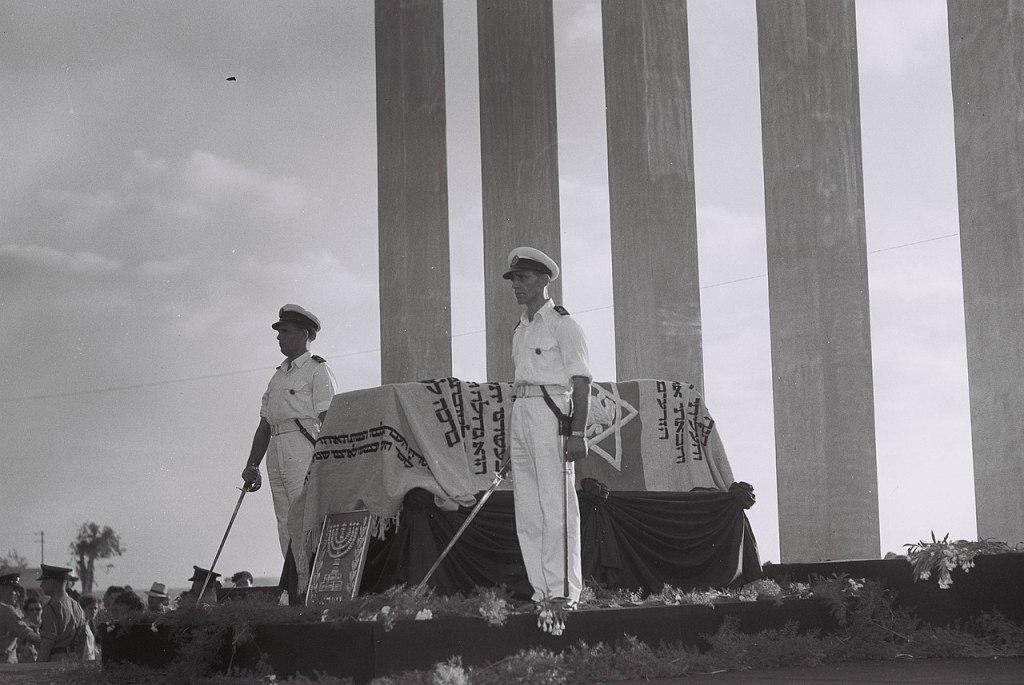
I opened my eyes. The fenced-off plaza near the ocean was flooded with light. Across from us on a high platform lay the casket, draped with the Jewish flag and encircled with tall electric lights in the shape of stearin candles. Two soldiers stood in front of the casket. They stood at attention, straight as bowstings, like statues with unsheathed swords in their right hands.
The military police led the line of people past the casket in a single file, not letting anyone linger for long. “Do not stop,” they kept repeating, because the mass of people was limitless, impossible to count.
p.88
We braided our way into the row and, treading slowly, we approached the casket. When we had passed the casket and I looked towards the exit path from the boardwalk to the ocean, I noticed something behind the casket, right next to a high wall that had been erected to divide the casket from people who went outside the queue. A Jew was sitting there in a corner, rocking over a large volume of the Mishna. The Mishna lay on a tall stand, with an ordinary stearin candle burning there. The devout man rocked and hummed a traditional Gemara melody, his yarmulke raffishly tilted on the top of his head.
We set off home. There was an ambulance from the Mogen Dovid Adom a couple of hundred meters from the intersection. Nurses, several doctors, and a fair number of helpers sat on benches near the ambulances.
My relative asked: “So, have there been a lot of accidents?”
“So far, not a one,” answered a young doctor, “and it’s already almost two o’clock.”
It took us a full hour to drag ourselves home. I lay on my soft well-made-up bed for a long time and could not sleep. It’s strange. There are no surprises in Jewish history. Over three thousand years ago, according to the tradition, Joseph’s bones were brought here. Now Herzl’s. I thought: How would Herzl feel if he could see the parade people made around his casket with his own eyes? Surely, he would have been happy. He had likely seen generals, city leaders and other noteworthy dead people lying in state in their caskets in Vienna, bedecked with flags and with an honor guard of soldiers with unsheathed swords. Even the Jew with the yarmulke who sat tucked in a corner bent over the Mishnah was in “good taste”. Religion has its place in a modern state. It cannot have any authority, but it may not be ignored either. Yes, Herzl would have been happy. If one asked a Western European Jew how to receive a casket of a returning leader, he would say that one should make a parade just like the one they made.
p. 89
But on the other hand! What would someone like Ahad Ha’am have said about such a spectacle? Would it have made him happy to see this casket wrapped in flags and with two soldiers standing guard with their swords drawn, while off in a corner a Jew rocked over a Mishnah?
I knew the answer immediately. I recalled what Ahad Ha’am wrote about Herzl’s depiction (in his book, Old New Land) of Passover in his dreamed-of country:
“It is like monkeys imitating, without a trace of independent national content, and the spirit of ‘slavery within freedom’ is everywhere.”
The next morning at breakfast my relative said, “I could not sleep all night. I heard you tossing and turning. I’m telling you, Happy are we who have lived to see such things with our own eyes.”
I did not answer. He looked at me, put down his knife and fork and said: “Aha. I see, now, that something about it displeased you. Probably, it did not agree with your Yiddishkayt.”
I calmly admitted that in my sleeplessness I got to thinking, and added that I didn’t think it was right to make such a goyish spectacle.
He sighed. “You never let up. It seems like everything is well and good. Then, suddenly, aha! Off you go again, demanding the impossible. Who could satisfy you? Who, I ask?”
Maybe he was right.
(click here to continue reading Chapter 9)
[1] Before shekls were an Israeli currency, the word was used to refer to membership cards or dues in an East European Zionist organization.
[2] See Genesis 22:17.
 The Nation State and the Promised Land