
The Nation State and the Promised Land: An American Yiddish Writer in Israel, 1949, by Solomon Simon. English translation, 2024, by David R. Forman. All rights reserved.
Page numbers from Medines Yisroel un Erets Yisroel, 1950, Farlag Matones (NY), are included for those who wish to follow along with the original Yiddish, below.
To begin with the Introduction, click here.
Day in, and day out, there was a pure, deep-blue sky and bright sunshine. When you got up in the morning you could tell it was definitely not going to rain. The brightness and sunniness were deeper and more tangible than in America. And the nights? Ma yafim haleylot bekhnan, “How beautiful are the nights in Canaan,” as the poet[1] says. It’s good that the poet was spare with words and did not try to describe the nights in the Land of Israel. You have to stand on a veranda yourself, late at night in a small town or in a kibbutz somewhere, to truly feel the beauty and tranquility of the night, the silvery shine of the moon, the brightness of the stars and the clarity of the air.
The first couple of weeks you are intoxicated by the climate. You cannot get enough of the warmth, the light, and the dryness. But, bit by bit, it gets harder for you to move around in the middle of the day. You need to lie down in the afternoon. You begin to take care not to walk midday without a hat, and you feel like you cannot move as quickly and spontaneously as in our climate.
Nevertheless, you do not feel heavy or bedraggled. You do not feel the weight of your body the way you do on a hot day in New York. On the contrary, in your body’s half laziness, you feel a mental alertness, an exaltation, and a constant ecstasy. The senses are sharpened and you are receptive to everything around you. You begin to think that…
p. 91
the exaltations of the prophets could have arisen only here. You begin to believe that the passage in the Gemora has something to it: The air in the Land of Israel makes people smart. It makes a person more alert, and he can grasp things quicker and more deeply.
I write all of this because it occurred to me that over the course of the three months I was in Israel, I do not remember a single day that weighed me down with emptiness, boredom and purposelessness. Every day was like a tautly-drawn bow, filled with expectation, with inner restlessness and with joy.
True, I traveled a lot and walked around a lot, and these impressions needed to be digested and made my own. But still, there were days when I sat on the porch with my brother and did nothing but read, smoke, write, chatter with children and look at the occasional passerby.
But it could also be that I was not emotionally oversaturated because life was both different and familiar. The whole heritage of ancient times and of the recent past gave it an old-new character I could never get enough of. I was in the category of an older man who comes to his old home and every detail reminds him of his happy and carefree youth and, at the same time, in the category of a child who is seeing things for the first time.
And so, each trip, though often not more than twenty or thirty miles from Ra’anana, was an event for me.
Before I set out for the kibbutzim, I got several smaller trips out of the way. I have a lot of childhood friends in Israel. I have three close friends in particular: one in Holon, near Tel-Aviv (about which I will talk in another chapter), and two younger friends in Kfar Hogla.
Kfar Hogla lies in Hefer Valley, or better, in the Hefer region, a small part of which is in the former Sumaria and the larger part in the former Judea. But Kfar Hogla is in the part that was in Sumaria, at the foot of the Mountains of Ephraim. Right next to Hogla are the village of “Kfar Haroeh,” (which is really named after Rabbi Kook, but the inhabitants interpret it as the village of the seer, meaning the prophet) and the kibbutz “Givat Haim”.
The words themselves: Hefer Valley, Mountains of Ephraim, Village of the Seer, are really not…
p. 92
just words. For those of us who studied Torah, they bring up images and associations that have left marks in our souls.
I was interested in why the village was named Hogla. The explanation given to me was as follows:
“According to the commentaries, the five daughters of Zelophehad [צלפחד] were names of cities found in the Hefer Valley. The founders did not want to name the village after Zelophehad’s first daughter, because Makhala means ‘illness’. The second daughter was named Noa, which means a wanderer, and that was not a fitting name either. Therefore, the village was named for the third daughter, Hogla, which means ‘dancer’”.
I was told it took long nights of discussion until they could come to agreement on the name.
Kfar Hogla is not far from Ra’anana. With a good car the whole journey would not take more than twenty or twenty-five minutes. But with the Israeli buses, the trip took almost three hours, and it seemed like God knows how far. It accorded with the concept of Ephraim Mountains. The Mountains of Ephraim cannot be right near where you live. They must be God knows how far.
We were not able to get a ticket directly to Kfar Hogla. We bought a ticket to Kfar Haroeh. The driver left us off near the sign of “Kfar Haroeh” and told us to take a right at the corn fields.
My brother, my daughter and I followed his direction. We went off on the sandy road that wound between the fields. We walked and walked, and did not see any sign of a settlement. Suddenly we saw figures approaching in the distance. We stopped and waited. Better to ask than to get lost.
I sighted a Yemeni Jew with a thin little beard and long peyes. He was leading a small donkey. A boy around twelve years old drove the donkey with a cut branch. I stood there, agape. Against the backdrop of the green fields, they looked just like they had stepped out of a page of the Talmud.
We greeted the Yemenite Jew and asked the way to Kfar Hogla. He stopped and began to chant directions in an exotic melody.
p. 93
“If you go straight it is around three kilometers to Kfar Hogla. But you will have to go through vineyards and orange groves, which would not be an easy path. Better would be to go back to the highway and go right until the fork in the road. Go right again onto the new road and you will come right to Kfar Hogla. Oh, come on, you are going to say,” he said in the strange melody that was like some kind of cross between a prayer and our Gemore nign[2], “you have already walked more than half a kilometer to get here? Well, it is a loss you can’t get back — it’s done.”
We walked back with him to the highway. He told us that he has been in the country for twelve years. It was hard, very hard, for him to live. Now that a Yemenite community has settled here in an abandoned Arab village, it is easier for him. He has a roof over his head, a bit of a garden and a field. Plus, he has worked in an orchard for years. But he is a poor man, one of the little people and, he startled me by saying the two words in English, he does not have any “Vitamin P”, which means, patronage. If had had a little respect in the community, he would have been given a better house, and his bit of a field would be closer to the village.
We were back up on the road, said goodbye to the Yeminite and thanked him. We set out for Kfar Hogla. We had walked a fair bit, but still had not seen a sign. We noticed a group of workers, working on the road. We stopped and asked them the way. A middle-aged man wiped the sweat off his forehead and answered. “Go shtraight on this road. You’re walking in the right directsen. You cannot mish the sign. It’s not hard to find the village.”[3]
Having finished talking, he gave a big sigh.
“Ah, my Litvak,” I answered him, “but why are you sighing like that? It is written, Bezeyes afekho… By the sweat of your brow shall you earn your bread.”
“Yes,” the Litvak answered, “it is so written. But have you ever done roadwork, my American uncle, and had to speak Hebrew on top of it? I do not have the shtrength to do both at once.”
We easily found the intersection with the…
p. 94
sign for Kfar Hogla, under a bigger sign reading “Givat Haim.” We turned onto the road to the village.
Apparently, the road was a lot longer than everyone thought. Or maybe we were tired from the heat and from having gotten lost. We walked and we walked. There were green fields on both sides, with sprinklers watering the vegetables. It was beautiful to see the spray of hundreds of thousands of drops of water, creating rainbows. But the pleasure couldn’t really sink in, because we were so tired and so thirsty.
The road led us through vineyards and orange groves. It grew shady and cooler. The heat no longer exhausted us, but the thirst had not let up.
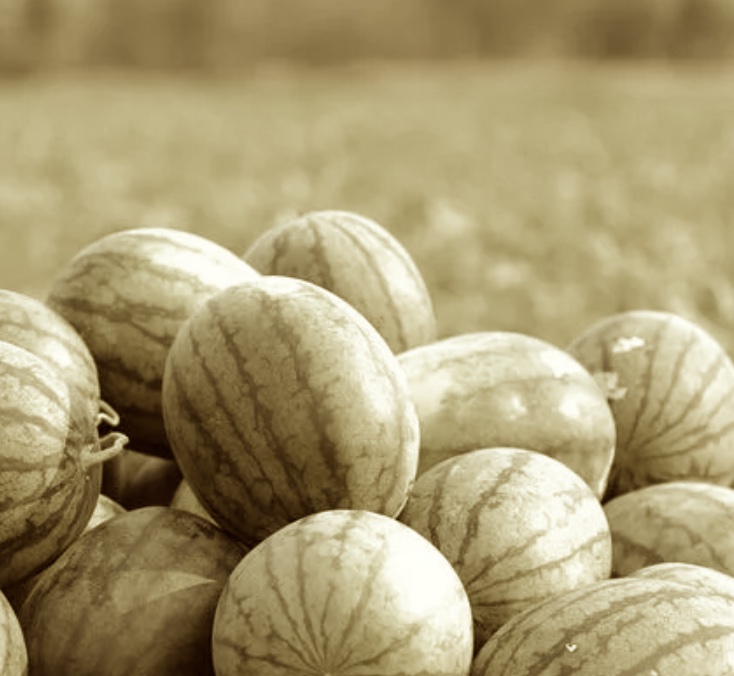
We came to a narrow road, right beside the fence of a vineyard. There was a little wheelbarrow with watermelons. We stopped.
“Let’s take a watermelon,” I said, “and slake our thirst.”
My daughter protested. “That would be stealing.”
My brother said, “Let’s call someone.” He put his hands to his mouth and yelled. “Bal-Hakerem! Eykho? (Vineyard proprietor, where are you?)”
The expression sounded strange and exotic. For me, the word ‘eykho’ brought up associations with the Chumesh, when God called to Adam, “Eykho— Where are you?” But even more, the simple expression ‘bal-hakerem’. It reminded me of a passage from the Talmud[4]: The proprieter of the vineyard (i.e. God) shall come and wipe out the thorns. There stood my brother calling out: “You, God, where are you?”
My brother repeated his call again and again. No one answered.
“So, we’ll open a watermelon,” I said, coming back to the present. “Nobody answered.” My daughter was not satisfied.
p. 95
“No. It’s still stealing. You shall not steal.”
I made a compromise. I wrote a receipt and stick it to another watermelon with a pin.
“I, Doctor Shloyme Simon, from Brooklyn in America, temporarily residing in Ra’anana, have taken a watermelon without your authorization. If you write to Ra’anana, I will send you the five piasters (15 cents).”
My daughter was appeased, and we opened the watermelon and slaked our thirst.
We arrived in Kfar Hogla.
——-
My two friends live next door to each other. I came in through the yard and found them in the vegetable garden, sorting tomatoes, green peppers and cucumbers. They both stood there, dressed identically in pants and undershirts, barefoot and bare-headed. Their hair had not been cut for months. They looked like typical peasants. Naturally, they did not recognize me, but they knew my brother and guessed correctly who I was. Zalman, the younger one, clapped his hands, and said, “Shloymke! Finally, you’ve come to us. Wait, let me wipe my hands on the grass and give you a proper handshake. Nu? Meyer,” he turned to his friend and neighbor, “did you recognize him?”
Meyer also wiped his hands. “If he had a beard, he would resemble his father. But recognize? After thirty-eight years you wouldn’t even recognize your own brother.”
Inside, there was a celebration. Both of their wives were also from my shtetl. There was a brief squabble over where we should eat, until they finally decided to take the table out onto the veranda and bring out food from both kitchens.
“Black Hannah,” as Zalman’s wife was known, said, with real regret:
“If we were expecting you, we would have prepared a hot meal that would really be delicious. But what can we give you now? Kalinkovitch food. A perlgroypenem kripnik [barley soup], fish-potatoes [a potato soup with fish], and blintzes.”
“Listen, Black Hannah,” I said. “It’s good that you did not expect me and prepare fancy…
p.96
pastries. Serve the comfort food and let’s enjoy it. It’s been a long time since I had any fish-potatoes or a homemade kripnik.”
Zalman brought out a bottle of wine from somewhere and smacked the top with the palm of his hand, sending the cork shooting up to the ceiling. We poured the wine, toasted lechaim, and sat down to eat. After the meal, once the table was cleared, another bottle of wine was brought in. We drank, smoked, and started our conversation.
They explained to me what a worker’s moshav means, and how the cooperative works. I listened patiently, as though I was completely unfamiliar with the subject. It’s very curious to see the enthusiasm of the Israeli Jews. Every one talks about his moshav, his kibbutz, his region, as if as though there was nothing similar in the whole of the Yishuv. Each of them had started from scratch and speaks with the pleasure of the creator.
After a while I began to pose questions. I have to admit that my questions were not tactful ones. Fundamentally, I was interested in provoking or interrogating people to get at the real answer, not the rehearsed, accepted, or cliché answer.
“Listen,” I said, “I have known you both since you were boys. You come from fine Jewish families. Your fathers knew how to study. Both of you, as far as I remember, were also good students. You knew your way around a page of Talmud, and were acquainted with both Hebrew and Yiddish literature. You were what we once called intellectuals. Nowadays, I guess we would say ‘intellectually progressive young men’. I ask you, is it an achievement to come to Erets Yisroyl and become simple peasants, just like the peasants in the villages around our shtetl? The two of you look just like Kartsayer muzhiks (Kartsaye was a village near our town, with very lowly peasants).”
Zalman answered.
p. 97
“Let Meyer talk. It’s true I am a closer friend of yours, but he speaks better than I do.”
And Meyer spoke:
“Yes, on the outside we look like the same peasants as in Kartsaye or Dudovitch, but with two exceptions: We became peasants consciously, and our cultural level is no lower than it was in our fathers’ homes. Of course, we don’t have the same values. We read at least one newspaper a day, sometimes two. We pick up a book. I ask you, what Kartsayer peasant had a bookshelf in his house? We send our children to high school. Did they do that?
“I said we became peasants consciously. We knew from the beginning that we were taking on a very low economic level for a certain time. We freely relinquished all the urban comforts. We argued that there was too much “silk” in the shtetl. Do you remember S. Ben-Zion’s story, “Meshi” (Silk)? A city full of young men dressed in silk, without a floor beneath their feet. We decided to root ourselves in the land. We didn’t just sing “In der sokhe ligt di mazl-brokhe”[5], but we began with ourselves. Made the clean break ourselves.
“And another thing. We wanted a little more security in this non-Jewish world. I know full well that the misfortune that our brothers met with over there could also have happened here. But it would have been different here. We would have been able to position ourselves against our enemies better than they could. Here there were not only cities, but also hinterlands. There were a lot of Moshavs like ours in the country. Groupos of several houses far from the main highway, tucked into the woods and close to the mountains. We would not have been as helpless as they were. And you, too, could end up like them.
“On the outside we are peasants, like any peasants in the world. You saw it yourself: We work in the fields in pants and an undershirt. We are sunburned. We move slowly and deliberately. From a certain point of view we are like the children of Noah, who may be executed for a groshen[6]. Our subsistence is that hard to come by. But we are different, after all. As you would say: ‘We are Jewish peasants.’ Jews are different.”
p. 98
He stopped, and said apologetically:
“Here I gave you a whole Zionist speech, and I hate speeches, and Zionist speeches above all.”
I did not drop it, though.
“Altogether you have fifty dunams of land. With intensive cultivation you can get by as is. But what will you do with the children? A peasant wants his children to stay on his land. Let’s suppose it doesn’t bother you if your sons and daughters, if you have more than one, leave to found other moshavim or kibbutzim. Still, in order for the moshav to remain a moshav, you would have to keep at least one child with you. How can fifty dunems provide for two families?”
“This problem has caused plenty of sleepless nights,” he replied. We knew the only solution was to acquire more land. Our territory belongs to Keren Kayemet [the Jewish National Fund]. So, we tried to buy more land from the neighboring Arabs. But they wouldn’t sell. Now, after the victory, people say everyone should be given twenty more dunems of land. That is, everyone who has a son or a married daughter who wants to stay on their father’s land. Let the other sons and daughters go, as you said, and found other workers collectives or kibbutzim. The Sharon [Plain] is settled well enough, but the Galilee and the Negev are abandoned. If only we had enough people for that land that we have now.”
I kept asking questions. “You say you send your children to high school. How can such a small moshav afford a high school?”
“It’s hard. We partnered with another moshav. The children have to travel far. The problem is, we actually are like our fathers. We are ready to draw blood over the tiniest thing. It’s a long story, but I’ll make it short.
“The kibbutz Givat Haim borders us right here, starting right here, just behind Zalman’s fence. When we arrived here and had several children growing up, we thought we would have nothing to worry about when it came to a children’s school. Our children would go to school at the kibbutz. Of course we would carry our share of the…
p.99
financial burden. Well, the kibbutzniks said, ‘absolutely not.’ We complained to the Mapai and to the Mapam. Imru Elohim – Go yell at the wall. There was nothing we could do. We started our own kindergarten. But we had to send the older children to another moshav.
“And now you still have not come to an agreement?” I asked.
“Foolish question. You don’t understand the kibbutzniks. They do not even let their children play with ours. Some of us say it’s because they do not want their children to know that there are Jews who own their own house, have their own stable with a cow of their own, and a bit of a field, who nevertheless are not exploiters or bloodsuckers, neither are we hopeless cases, living off other people’s toil. But I think they are simply afraid for their own theoretical system. According to Marx and Engels, as small farmers we moshavniks ought to be backwards, reactionaries and enemies of the working class. You should understand that in the kibbutz the children learn that Moses brought the Jews out from Egypt and led them straight into the kibbutz. The couple of thousand years between the Exodus and the founding of the kibbutz were unimportant, a blank page in Jewish history.”
Zalman laughed.
“Nu, enough sermonizing, Meyer. Let’s show him our farm.”
I went with them, just as though I had not seen a single solitary farm in the country. I did not want to tell them that one chicken coop looks just like any other, that all calves have the same face, and that a vegetable garden is a garden with vegetables growing in it. Of course I couldn’t tell them that I could not get excited about their food stores. I could not say so, because they were walking with me to show me fiftteen years of toil and sweat, fifteen years of working and watering earth that had been neglected for a thousand years, which they had forced to grow vegetables and trees. Red earth, overgrown with thorns and dried grasses, now transformed into orange groves and vineyards.
They took me up to the top of the water tower. We could see the landscape for dozens of kilometers around. Just there…
p. 100
on the mountain, where it seemed as though you could reach them with your hand, were Arab villages.
My companion smiled and said:
“Yes, there is great danger. Our enemies live right under our noses. And there are enough refugees there in those Arab villages. Often, they smuggle themselves over to our side. When they’re caught and are asked what they are doing on the Jewish side, they answer, ‘We came to see what is happening on our farm or house.’ You will say we are in danger, a lot more danger than you are in the diaspora. But you should understand that fate has played into our hands. The Zionist fantasy we dreamed about has become reality, and the practical, reasoned speeches of yesterday’s ‘scholars’ have turned out to be wrong. I can remember it now, what your Yitskhok Isaac ben Aryeh-Tsvi Halevi Hurvitsh wrote. I have the second volume of his writings in my house and page eighty-one is marked with a dog-ear:
Not in Uganda, not in Jerusalem—the future Zion will be in liberated Warsaw.
“So, Warsaw is liberated. Where are the Jews? Now, after our current victory, we may be too optimistic. Of course there is danger in our exaggerated optimism. But when people have literally seen miracles with their own eyes, would you frighten them with catching cold?”
I did not have the heart to argue with him.
It had gotten late. We had to ride back. They drove us with a horse and wagon back to the paved road where the bus stopped. We said our goodbyes. The last thing they said was, “Stay here. Why are you going back? Are you going to wait until a Hitler comes to America? Here we will come up with an answer.”
This last speech was not new to me. I heard it on day one from a child, and from then on from everyone who had a mouth to say it with. By now I had been in the country for fourteen days. When I had sat down on the bus, I took a look at my notebook. It was the hundred and eightieth time that I’d heard this warning from the Jews in Israel. From that day on, I stopped recording and counting.
(click here to continue reading Chapter 10)
[1] Yitsḥak Katzenelson (1885-1944).
[2] Gemore nign. The tune to which the Talmud is chanted when studying.
[3] Here Simon switches some of the ‘sh’ and ‘s’ sounds to show the speaker’s Lithuanian Jewish (Litvak) dialect.
[4] A rare case where Simon misidentifies the source of a verse. The image of the neglected vineyard appears earlier, in Isaiah 5: 1-7.
[5] “In the plow, good fortune is found.” From the song The Plow by Eliakum Zunser.
[6] translator’s note: I don’t know how widespread this expression, or this thought was. I suppose it should be included under the header, “better to acknowledge than sweep under the rug.” https://www.sefaria.org/Yevamot.47b.6?vhe=William_Davidson_Edition_-_Vocalized_Aramaic&lang=bi&with=all&lang2=en
 The Nation State and the Promised Land