
The Nation State and the Promised Land: An American Yiddish Writer in Israel, 1949, by Solomon Simon. English translation, 2024, by David R. Forman. All rights reserved.
Page numbers from Medines Yisroel un Erets Yisroel, 1950, Farlag Matones (NY), are included for those who wish to follow along with the original Yiddish, below.
To begin with the Introduction, click here.
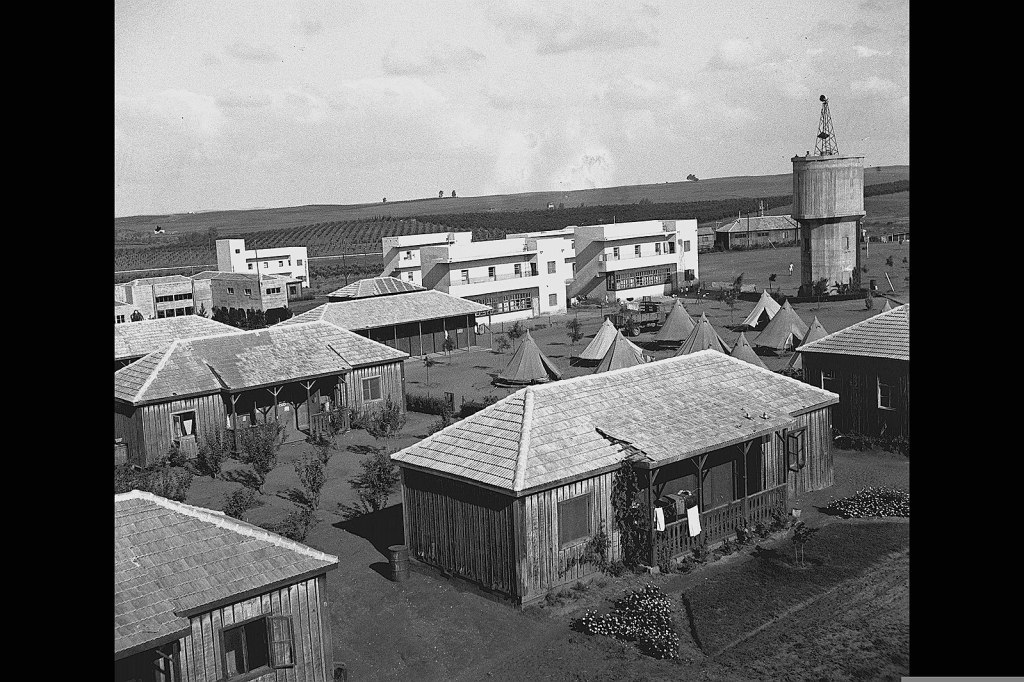
One of the oldest kibbutzim is right near Ra’Anana[1]. Getting there by bus is like getting the Hebrews out from Egypt. I hired a taxi. The trip cost all of a half pound (a dollar and a half), and it took sixteen minutes to get there. We came back by bus. The trip took around two hours, including waiting and a change of buses.
We arrived at lunchtime. I went in to the secretary and introduced myself. He shook my hand warmly and said:
“We have a custom in the kibbutzim to go and eat first of all. We should go to the dining hall. But, since you are here, I will show you our arsenal. Before, under English rule, we had to keep it hidden, so no harm would befall it. Now we are in charge.”
He led me into a locked side room and showed me all kinds of guns and other weapons. I am no expert on these things, and I do not know whether the rifles and light machine guns were first class ones. But there were a good many weapons there, enough to outfit a couple of hundred people. I played dumb:
And why do you need to have these weapons? Don’t you have an army now?
p. 108
He smiled:
“What do you mean? The party is over, and that’s that? How far are we from the border? Hopefully they will not be needed, but if we have to go back into the trenches, we will be on the front lines. A kibbutz must be prepared.”
“Do you have special groups who can handle these weapons?”
“Binoreynu U’vizkeyreynu— young and old, all of us know how to hold a rifle.”
“How is it the government allows the populace to be armed?”
“What, do you think they are afraid of us? It’s a Jewish government, and we are Jews, too… But enough. Come on, let’s go eat.”
We went into the dining room. It was a long hall that could accomodate four or five hundred people. There were long tables without tablecloths, with benches around the tables. We sat down at at table. They gave us plates and utensils. Whole mountains of bread were on the table. In the middle of the table was a deep bowl, which they called “Kolboynik”[2].
Everyone gets just one plate. When he is done with his salad, he cleans the plate off into the kolboynik and is ready to ready to take soup from a bowl on the table. When he is done with the soup, he puts meat on the same plate. The compote is served onto the same plate. There are no napkins. People wipe their mouths with their hands. In a lot of kibbutzim, they hang hand towels by the door. After the meal, people wash their hands and everyone wipes their hands with the same towels, like people once did at the ritual washstand in the synagogue.
The food was simple, but tasty and nourishing. You could take second or third portions.
The secretary began showing us around the kibbutz. He pointed out their property: A wood shop, a metal shop, a bakery, stables with cows and horses, a prize bull, chicken coops, storehouses with grain reserves, children’s quarters, a school, and apartments for the kibbutzniks.
“Every kibbutz strives for a diversified economy. This is an old principle of ours. We supply bread and cakes, not just to Ra’Anana but also to Netanya. During the war, we supplied bread to the army. Of course, all the profits go to the kibbutz.
p. 109
“Now we have a problem. We don’t have enough workers. The new immigrants do not want to be in a kibbutz. They call the kibbutz a ‘kolkhoz’ [a Soviet collective farm], a concentration camp, and who knows what else. So we have to hire day laborers. Hired workers are working for us. It’s definitely against our principles. But what are we to do? The fields, vineyards, and orange groves cannot be neglected. The work in the cow barn and horse stables absolutely cannot be set aside. We are forced to hire workers like any kind of capitalist organization.
“And now I will show you the points we defended and the places where we dug ourselves in against the enemy. I will take you up the water tower, and you will see how hemmed in we were.”
On the way to the water tower, we came to an clearing. He stopped.
“This spot has a whole history behind it. I’m sure you know that we were already well-known during the time when England ruled over us. You’ve probably heard how they looked for weapons among us. The drove us all together right here and searched us for weapons. One of our young men was killed during the search.
“The behavior of the English was not how we imagined an Englishman is supposed to behave. They were rude, brutal and cynical. But, nevertheless, an Englishman is not a barbarian. They looked and they looked and they could not find anything. So they wanted to tear out the floor of the dining hall. Our women, girls and children stood against them. They took pitchers, pots, and bowls of water and poured them onto the soldiers who wanted to tear up the floor. Well, it helped.”
We went up on the water tower.
“The Arabs could not be driven off with Lag B’Omer rifles[3]. This was a decisive battle: Us or them. Look, right there on the front of that hill there was an Arab village. There was another village to the right. The foreign enemy attacked us from behind. We were trapped as if in a vise. Just as the war began, we went out to the two Arab villages, and warned them…
p.110
that we would blow them up if they fought against us. One village was afraid and withdrew. The second village stayed and fought. Stayed until now. So, on one side we have enough land, and on the other side we are cut off from the land.
“We sent our children away. It was truly hell here. The fire came from two sides. We had to hold the kibbutz. It would have opened the road to Ra’Anana and Tel-Aviv. And how do you give up a kibbutz? Just leave it behind – life would have lost its meaning.”
“Losses?”
He sighed.
“It’s hard to convey the tragedy. Lets not talk about it. Even the fallen animals still tear at our hearts. An animal is not just a dumb creature to us. Every cow is raised here and has a name like a child.”
I asked him to show me the school. I wanted to see the building. He led me there.
The school was surrounded by trees. It had a large veranda, and the rooms were well lit, spacious and well furnished. A long room had wall newspapers and children’s compositions displayed on the walls.
I began to examine the children’s work. All the compositions were about the war. This was no surprise to me. The children had just returned to the kibbutz two months ago. Every child was preoccupied with the bloody events. The true character of the education could only be apprehended from an exhibit that did not have to do with the war at all, and from the work the graduating children presented.
The exhibit that took up the most space had been prepared by the whole graduating class. They had taken up two whole sides of the room. A long bench stretched over the length of the two walls. On it, the children had presented a clay model of the development of humanity from the cavemen to the present day. Civilized man stood on the Land of Israel. A magnificent map of Israel…
p. 111
and the surrounding environment had been sculpted out of clay, cement, and stones. Every bit of land that Jews had ever ruled was indicated with a special little stone. A large sign above read: “Moledatonu” – Our Homeland.
The big projects about the prophets were extraordinarily interesting. Considering that they were written by fourteen- and fifteen-year-old boys and girls, the work was very thorough. But they emphasized every place in the prophets that called for vengeance, that extolled war, victory, and national pride, and that gave promises of national glory.
We left the schoolroom. On the veranda, a middle-aged man sat, banging on a typewriter. A fourteen-year-old girl read a manuscript to him out loud, and he typed it out on the typewriter.
The secretary introduced him to me:
“This is our chronicler. We are keeping a chronicle like the Jewish communities of old used to do. Every week, everything that happens is accurately recorded. Now, because of the war, a lot of work has accumulated. Besides recording every detail of the battles, there are also biographies of the fallen, which will then be published anonymously in the press. He works on the chronicle three days a week.”
“And the other three days?” I asked.
“On the other three days he works at his trade,” my guide answered. “He is the kibbutz shoemaker.”
Later I browsed through the volumes of the chronicle. Everything was recorded systematically and clearly. Certain events and biographies were written with real talent and in a very fine Hebrew.
We went in to the secretary’s apartment. It was one room, ten feet wide by fifteen feet long. There was a bed, a desk, two chairs, a radio, a pair of portraits on the wall, two dozen books, and a dresser. We sat on the bed. He took a clay pitcher of water from a drawer and offered me a drink. We talked:
p. 112
“What do I have from twenty years of work? What do you mean? I have everything I need. Each of us has a room – newcomers in not especially good houses, and the old inhabitants in good houses. I am a widower, so I have a smaller room. Married couples have bigger rooms, where two beds can easily fit.
“Do you think one room is too little? Why? Our children sleep in separate quarters, in the children’s house. As for food, we eat in the common dining hall. The library is open to us at all times. We can have guests wherever in the kibbutz we want. So why do we need more than one room?
“What kind of clothes do we have? Here, look: There are plenty of work shirts in the dresser, along with two white shirts, a tie, underwear, four pair of work pants, and a suit with a pair of shoes for Shabbes. If our clothes tear, we get new ones.
“Newspapers? All the newspapers are in the library. Any pair of people who want the same paper have a right to order whatever they want, and get one paper privately for the two of them. If someone wants to read more than one paper, he can easily manage it. People swap. Of course, in our kibbutz, most people are members of either Mapam or Mapai. But there are other parties, too. We have no orthodox members, because we don’t keep a kosher kitchen.
“Books? Each member has the right to order however many books a year are allowed, based on the book budget. But the library is large. If someone has to have a book, the library will get it for thim.
“How do we raise our children? I would like you to understand: We are not interested in raising a generation of intellectuals who will run away from the kibbutz. We give every child a high school education, but the general studies go hand in hand with work. A child must do his share in the field, in the kitchen or in the factory, according to his age. We raise the specialists we need, but we see to it that the next generation stays here with us – not like the Jewish colonies in Argentina did, and not like the Jewish workers have done among you in America.
p. 113
“Talented children? If a child displays special talents, we see to it that he proceeds with his studies. Once, that was hard for us. Now, the kibbutz can allow itself such things. We even send children to study abroad.
“Yes, very often parents complain and make demands: We have not appropriately evaluated their child. But we straighten it out. Of course, there are sometimes resentments.
“Yes, it sometimes happens that someone does not do his day’s work properly. Well, a person is not a machine. If it becomes chronic, we try to find out why. Typically, in such cases there is always a reason. Often someone will need to change occupations. He is taken out of the field and put to work in the stables, or somewhere else.
“Travel to the city? If someone has to go into the city, he gets expenses. No one is permitted private capital. Everyone must give everything he has to the kibbutz treasury. There have been cases when a member has put hundreds and thousands of pounds into the treasury. This did not give him greater status. No one may have special privileges.
“Old parents of members are taken care of. Once, when we were young, this was not a problem. Now there are a fair number of old mothers and fathers. Luckily for us, the kibbutz is rich enough now, and can afford it. There are kibbutzim that have special kosher kitchens for the old people. They are also provided with a shul with a Torah scroll. Yes, needy relatives are frequently supported.
“New members? Yes, that’s a real problem. The new immigrants are not idealists. Besides that, they lived an imposed communal life for too long. Up to now there was an inviolable law not to hire any workers for wages. But now after the war’s destruction we have been forced to employ outside workers. We now employ nearly thirty workers from the outside.
“Our members who work in our factory are not paid any more. Put more accurately, a person does not get any extra reward no matter what expertise he has.”
“You will pardon me,” I interjected. “I see…
p. 114
a very nice bicycle in the corner. Since no one gets any extra pay, how did you get the bicycle? And right here that is a really expensive radio.”
“The kibbutz bought the radio,” he answered. “Last year the kibbutz bought each of us a radio. But don’t remind me about the bicycle. You know, our customs allow us to receive presents. Well, a year ago my sister came here, and brought this bicycle for my boy as a bar-mitzvah present, even though I don’t believe in bar-mitzvahs. So we were left with the question of whether it is right for him to use it. None of the other children here has a bicycle. Why should he be privileged? Yes, he uses it once in a while. He is, after all, a child. But I don’t like the idea. I think, though, that in a year from now we will manage to buy every boy and girl a bicycle when they reach a certain age.”
It had gotten late. I got up and took my leave. I apologized for all my pressing questions and for taking so much of his time.
“On the contrary,” he answered me. “It’s been a pleasure for me to meet you. We want these kind of probing questions. We are happy when a guest comes and wants to know everything. We have nothing to hide. You know everyone wants to brag about what he has. Our kibbutz is our own prized possession, and we believe we have something to brag about.”
I agreed. This was my first acquaintance with a kibbutz.
——
Two days later I went to visit another kibbutz that was also not far from Ra’Anana. To get there by taxi would have been too much of a luxury, so I went by bus. I set out early, because with waiting and changes the trip would require over three hours.
I went there with my wife, daughter and brother. As soon as I arrived at the kibbutz I went into the secretary’s office and introduced myself. The first thing he said was:
“Well, you probably have not eaten breakfast. Come to the dining room and have something to take the edge off your hunger. Lunch is not until one o’clock.”
p. 115
“Thank you,” I answered. “But before we go to eat something, I would like to see if you also have an arsenal. You see, I saw a whole room full of weapons in Kibbutz R-H. I would like to know, is their kibbutz an exception?”
“What kind of an exception? All kibbutzim still keep weapons. Here, see: You should know we stand guard every night.”
He unlocked a room and showed me the weapons, and started to explain each kind of rifle. I nodded my head as though I understood something about the subject.
We went to the dining room. A thought needled me: Here I am asking about weapons and it does not occur to anyone to ask me: “Who are you? Where do you come from? Let me see your passport.” My being Jewish is enough to certify that I belong to Israel.
Why did not sit in the dining room for long. We were given tea and bread with riba (jam). In two hours, they would be serving lunch. The secretary offered to accompany us and show us the kibbutz. I declined: “We want to walk around by ourselves and look at everything.” He did not argue with us. “By all means, go and look at whatever you want. But do not forget to visit our beyt-habra’ah (sanitarium), our hotel for getting well” (his words).
The kibbutz had a mixed economy, like all other kibbutzim. They had several industrial operations along with the usual farm: fields, vegetable gardens, cows, chicken coops, orchards and vineyards. My wife and my bother stayed behind and sat in a lovely park near the beach, while my daughter and I slithered into a field. We met a group of young men working. I greeted them. I began asking them questions: “Who are they? How did they come here? What are they doing? Are they kibbutzniks?”
A young man began answering me in Hebrew. His Hebrew was halting. He asked:
“Does your daughter speak Hebrew?”
“Quite poorly,” I answered.
“And Yiddish?”
p. 116
“Yes.”
“Then let’s speak Yiddish. You see, I have only been in the country for a year and a half. When I’m working, I speak Yiddish. After work, when I relax, I speak Hebrew.
“Who are they? They are people from the Youth Aliyah—young people from Europe: from the concentration camps, from the refugee camps, from Poland, Rumania, Czechoslovakia, and who knows where else.
“How did they come here? They were brought here. Haven’t you heard about the Youth Aliyah? The government, or an agent of the government pays the kibbutz four of five pounds a month for them (a little over twelve dollars). For that they are given food, a good place to sleep, clothes, entertainment and an intensive education. The work half the day, and learn half the day.
“They are a group of fifty under one madrich (a guide, an educator, a leader). There are three such groups here on the kibbutz. Every kibbutz in the country has from one to two hundred of these young people.
“Is twelve dollars a month very little to support a young person? Of course. But this is a community service of the kibbutz. Surely it costs the kibbutz a good many pounds a month. But because of it, they are educating new kibbutzniks. A group such as this is called a garin – a kernel of a new kibbutz.
“No, not everyone adapts. If half a group remains, it’s a truly good garin. Sometimes only a few remain. But those few are tested and loyal camrades of the party, good material for a new kibbutz.
“Yes there are also hundreds of other young people from the Youth Aliyah. They are children from fourteen through eighteen years old, who attend high schools, or have graduated from public [primary] school. They come to work for four weeks. For them is a kind of vacation work-month. These youngsters are under the supervision of special madrichim, appointed by the kibbutz. But so what! Those are children from well-off families. They eat more than they work.
“Are you staying overnight? No? That’s a shame! We would love to tell you all about it. You are going on a longer visit in the Jezereel Valley? Good, you will be able to see our group there.”
At twelve o’clock, they put away their work and went to eat. I met quite a few of them. I sat at their tables with them…
p. 117
for a good long time and chatted. The usual life stories, that you hear from rescued Jews everywhere, horror stories, so horrifying that you cannot take them in.
What sticks in my memory is how noisy they were at the meal, their natural demeanor, their feeling that they are at home and have overcome all their woes, and the mixture of Hebrew and Yiddish in their speech, often with other languages as well.
After the meal we went to visit the hotel. Right on the ocean shore, among pine trees, there stood a fine two-story building with a sign: “Sanitarium”. Around the house were tidy one-story houses – bungalows with all the modern furnishings.
It was the post-lunch hour. Near a thick little patch of woods, dozens of guests lay stretched out on beach chairs, resting.
I went into the hotel. The director welcomed me warmly, as people did everywhere in Israel. She showed me their truly well-appointed kitchen: They had a large electric oven, fine electric refrigerators, an electric dishwasher, and all kinds of cabinets. She simply forced us to taste the fine baked torte that she had prepared for the guests, and to drink some tea.
“Yes, she directs the hotel. The kibbutz sent her to take special courses. She’s also worked in the finest hotels in the county. Yes, of course it was the kibbutz that sent her there to work. The hotel brings in a good several thousand pounds a year. This is one of the kibbutz’s enterprises.
“Everyone who works here is a kibbutznik. The person who gives out the work assignments, decides who will do what. Of course people comply. If someone is suited for this work and wants to stay, he stays. When there are more guests here, I say we need another this or that many dishwashers, this or that many more girls to look after the rooms, and they send them to us.”
We sat on the porch, drank tea, and talked with her. There was a flower garden right next to the steps. The garden was paved with colored asphalt and lovely eight-sided figures. In the middle stood a fountain that watered the flowers.
A middle-aged woman stood there, washing the pavement with soap. I quietly asked the director:
p. 118
“Who is she?”
“What do you mean, who is she? A kibbutznik. One of the first, of the founders.”
“Is this a job for one of the oldest kibbutzniks?”
The director laughed out loud and turned to the woman. “Do you hear what he said, Shifra? Why is it worth all that effort for you to clean the asphalt?”
Shifra rested her chin on the handle of her soapy rag mop, took a look at me, and said:
“If you had come here as I did twenty years ago, and dried the marsh, carrying sand on your shoulders, filling the holes, planting trees, and lying in bed with malarial fever; you would not talk that way about any of the work in the kibbutz.”
She sighed and gestured with her hand:
“Oh, I still remember the meeting when we discussed putting in the hotel. Do you think the first house looked like the little palace we have now? And I (here she suddenly switched to Hebrew) expressly wanted a fountain in the middle of a flower garden, a garden with a variety of flowers and colored asphalt around it. So, whose colored pavement am I cleaning?”
“Do you live here in the hotel?” I asked her.
“Who wants to live here? Don’t I have a home and a husband? My room is just as big and as beautiful as anyone’s in the kibbutz. I am one of the veterans here, one of the old ones. We even have radios in our homes, everyone in their own home.”
Someone came to tell me that the last bus was leaving the kibbutz in fifteen minutes. We returned to Ra’Anana late in the evening.
(click here to continue reading Chapter 12)
[1] Based on Simon’s description of the kibutz and on its location, its history, and the initials R-H (supplied later in the text), this is Kibbutz Ramat HaKovesh.
[2] Jack of all trades. Also, a rascal.
[3] Lag B’Omer is a minor, and festive, Jewish holiday. Traditionally, children play with toy bows and arrows and, by the time of this writing, other toy weapons as well.
 The Nation State and the Promised Land