
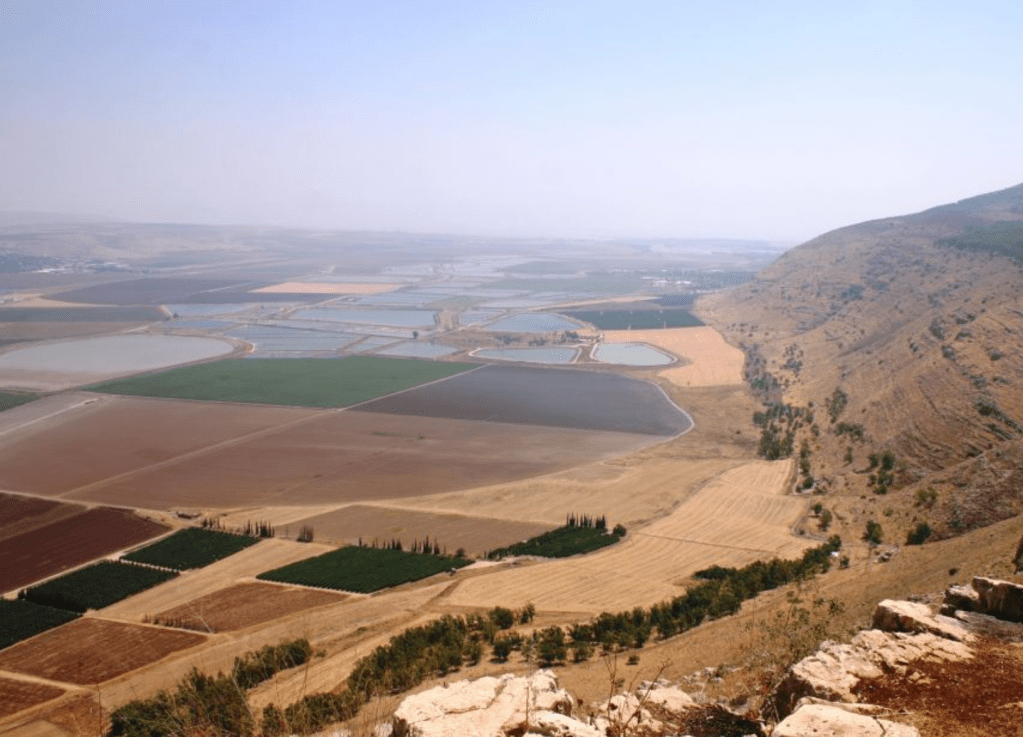
Not far from M-H, at the foot of Mount Gilboa, are two kibbutzim. They are not among the extreme kibbutzim. I told Sholem I very much wanted to spend two days there. He said to me:
“The poet G. is there, and the fiction writer Sh. I will give you a letter to them and tell them that you are a Yiddish writer and editor. They will treat you as an honored guest.”
“I do not want to be an official visitor,” I replied.
“So, then just go on in to the secretary and tell him that you want to stay in the kibbutz for a couple of days.”
“I don’t like that either. Who wants to impose on people and be a freeloader?”
Then Sholem remembered that they have a special hotel for tourists there. I left the kibbutz with my suitcase and went to the main road where I had to wait for the bus. A soldier with a wounded leg sat on the grass, also waiting for the bus. I sat down next to him.
In Israel, it does not take long for people to meet and start talking to each other. When he found out that I am an American, he began to tell me about the war. He told me a lot of things,..
p. 136
most of which was repetition of what I had already heard. But one episode, which he told me almost in passing, demonstrated to me that some of the Israeli soldiers are different than the others, after all. He spoke to me in a good literary Yiddish:
“We were in position defending Jerusalem. Our rifles were old and we had very little ammunition. Artillery shells rained down from the other side. The Arab Legion had the newest weapons, and we were standing there with rifles from the stone age. We were in dire straits. The orders we had were strict: Do not shoot unless you have to. Every bullet must have a purpose! It was not easy to follow these orders. But we followed them, because we knew that if we shot without a target we would not have any bullets when we needed them.
“All of a sudden one evening, the news arrived: New rifles had come, along with enough ammunition. We took the rifles right off the trucks and tore the wrapping off of them ourselves. The rifles were well oiled and ready to fire. And the bullets? Whole crates full of them. I grabbed my rifle and hugged it to my chest, the way a man would embrace his bride.
“Suddenly, I got a knot in my stomach. ‘Shmaya [his name], look what you are rejoicing over. It’s a weapon, an instrument for killing human beings!’
“But I was happy, nevertheless. I could not help it. With guns like these in our hands, we would be more likely to stay alive than with the old guns. And, I ask you, who wants to die?”
“Where do you come from?” I asked him.
“I’m from Kovno,” he answered.
The bus came. I rode for three-quarters of an hour. The driver stopped again in the middle of the road, and pointed me the way to the kibbutz. It was a tough stretch of road to walk. I arrived exhausted, overheated and hungry, and went into the dining room.
I sat at a table. No one asked me who I was. A member called over to the girl who served the…
p. 137
table and asked her for a plate, knife and fork for me. I sat and ate. I finished eating and asked someone, “Where is the hotel manager?”
A middle-aged woman arrived and introduced herself as the manager. “Yes,” she had a room.
I told her that I was very tired and asked her whether she might have someone who could carry my suitcase.
“No,” she answered. “Usually the buses with tourists drive right up to the hotel, which is on the hill. It’s not worth it to have special people to carry things. But,” she said, “I will carry your suitcase.”
“What do you think,” I answered, “I will let a lady carry my valise? What would my conscience say?”
“Oh, you talk like a kibbutznik. Come, It’s really not that far.”
I confess that after a few days in a kibbutz, the hotel truly hit the spot. The lovely colorful tiled walls, the thick Turkish hand towels, and the privacy of the shower were especially appealing.
After the shower, I lay down to sleep. When I awoke, a man was waiting for me. He introduced himself: He was a painter, and the director of the kibbutz art museum. It is worth seeing, he said. He was especially happy that I’d come. He knew me. He had my book, Kinder Yorn fun Yidishe Shrayber. Might I like to see the museum now?
I excused myself. Just then I wanted to get my fill of Mount Gilboa. In the evening, I wanted to see the kibbutz on my own. I could spend the next day with him.
When he was gone, the hotel director told me that this man is in fact a famous painter. He is an old kibbutznik and began to paint here. The first years on his own time, after…
p. 138
work. When they saw that he was actually talented, they began freeing up two days a week for his work, then three days. Now he occupied himself only with painting. He is also the director of the art museum. Everyone knows him as a lover of Yiddish.
“Does his wife work on the kibbutz?” I asked.
“Of course. What king of a question is that? She is not a painter.”
Meanwhile, she asked where I wanted to eat dinner – in the dining hall, or there in the hotel?
Embarrassed, I said, “I miss having a tablecloth and a napkin.”
A young man in the corner stood up.
“See, what did I tell you? Your kibbutzim are not for civilized people.”
The manager waved her hand dismissively.
“Don’t listen to him, he is a bourgeois!”
At dinner I made the young man’s acquaintance. He had a bulldozer, and worked for the kibbutzim. He did not think highly at all of the accomplishments of the kibbutzim. He spoke even more critically of them than the storekeeper in town.
That evening, I went strolling around the kibbutz alone. I confess that I snuck around looking into the windows of a lot of tsirifim (barracks) and in the rooms of the veterans. I wanted to see how kibbutzniks live in their rooms. I found few people in their rooms. The ones who were there, sat and read, or passed time with a neighbor who was in visiting. Radios played. Homes like any homes.
I went up to a large well-lit tserif. I heard a trained speaker talking. He was speaking passionately about something. I walked over to an open window and saw a group of young people, sitting on a long bench. Opposite them, in the middle next to a table, sat a young man exhorting them.
At first, it was hard to grasp what he said, because he talked with a soft ‘l’, with the half ‘sh’ and the ‘kh’ like a…
p. 139
true Sabra. But when my ear grew accustomed to the sound of his pronunciation, I was able to get what he was saying:
“It is a hard and fast rule that if you raise a hand against another you are driven out of the kibbutz. OK, you are new here, freshly arrived, and we look the other way when you hit each other. But knives? We collected a total of eight knives from your rooms. Another hard and fast rule in the kibbutz is no stealing. And you? Every day something goes missing from the group or from the workshops.
“I know, I know, it is hard for you to accept that you may not steal. You can just say what you want, and it will be provided to you by the kibbutz. Hitting? What for? Here, you are living a communal life. No one has more than anyone else. It is hard to get used to the idea of communalism. You come from cities where people believe that the more you pocket, the cleverer you are, that the richer someone is, the more honor he has. Here in the kibbutz, we don’t pocket anything, because no one is going to get rich or richer. Here, everyone is the same.
“I am talking to you like to grown up human beings. You are not children. A lot of you were in the war. I hope that it is the last time that I will have to talk to you like this.”
He finished, got up, and left the room. While he was talking and the group was sitting there, it had seemed to me that none of them was paying so much attention to him. But strangely, as soon as he left, a huge commotion broke out. Each one pointed a finger at the others:
“It’s your fault! You stole the straight razor today!”
“I will give you ‘stole’,” the boy answered. “I’ll shut you up with one punch in the snout”
A boy sat on a bench and pretended to be sleepy. A Yemenite girl gave him a shove so hard it almost knocked him off the bench.
“Now he’s sleeping. He cannot count to two, my brother!”
“They ought to give it to you right in the belly,” raged a boy with hair like a negro’s, “right in the belly and knock your guts out. That will make you into human beings.”
p. 140
I could not hold it in anymore and burst out laughing. Their readiness to curse at and hit each other, because they were not allowed to curse at and hit each other, was funny.
The whole group turned to the window.
“Mah yesh?” (What does he want?)
I calmly explained that I am an American Jew, and that I had been standing there listening the whole time, to what the madrekh had said to them, and how they were ready to hit each other because people are not allowed to hit.
“For an American Jew, you speak good Hebrew,” said a boy. “Come inside.” He turned towards me. “Climb in the window.”
“The door is only a meter away,” I said. “Why climb through the window?”
“Let him be! He is old, let him come in through the door.”
I went into the tserif. They sat me down in the mentor’s place and began bombarding me with questions. I did not let them. First I wanted to know more about the group and about the leader, the madrekh.
“Yeah, he is a good guy. He is alright. He was in the army, a big commander. Came back to the kibbutz and is right back in the refet (stable).”
“That is why I don’t want a kibbutz,” said the Yeminite’s brother. “They make an aluf (officer) into a horse groom.”
“Fool! It’s just the opposite!” answered his sister. “A horse-groom from a kibbutz can become a segen (lieutenant), an aluf. But from the city?”
“You with your kibbutz!”
“Yes, I’m staying in the garin (the kernel).”
“Who told you I am not staying?”
A boy who you might take for anything, but not for a Jew, nor for white, made his case with his hands:
“But you are still arguing. Sheket! (Be quiet!). Let us find out who the American is. Maybe he is a millionaire. Maybe he works in the movies?”
p. 141
I said that I had to disappoint them. I was just a Yiddish writer and an editor of a children’s magazine.
“If that’s true, that’s good, too. Print each of our names in the magazine. We will correspond with American girls.”
Separately and all at once, they began to describe what kind of girls they wanted to correspond with. I cannot tell you the details, because the censor would not let it through.
I got down to asking about the group. This was a group of boys and girls, almost all of whom had lost both parents. They had been gathered from every corner of the country. Many of them had served in the army. The Etzelniks had a lot of fifteen and sixteen year-old boys and girls among their ranks. Most of this group were Moroccans and some were Yemenites. This was the first time I had seen Yemenite girls among a [mixed] group. Each of them told someone else’s biography. They could not say enough about one of them, whom they called “Jungle”. He came from somewhere deep in Morocco. He had smuggled himself in through Egypt, where he had gotten onto a cargo ship. He was a machine gunner in the war. He could get by without food and water. When he got very hungry, he ate live mice.
“Go ahead,” they challenged him. “Show our guest how you eat a live mouse.”
“He agreed, and they were ready to find and catch a fieldmouse. I begged off. So, they suggested that he yell out the Jungle-Call for me. He prepared himself , and then let out a wild scream, smacked his hand over his mouth in order to interrupt the cry, then another scream and another clap over his mouth. Three times. The group beamed at me as a shiver ran through my body.
Among the forty in the group were about ten who were Sabras – children of our Jews. Later I learned that this was done intentionally. Children from good families[1] were included in order to provide some kind of control over the group.
When we had talked our fill, the Sabras asked some of the dark-skinned boys, Jungle included, to sing something. They…
p. 142
had to be pleaded with for some time. Finally, after I intervened and doled out two packs of cigarettes, they gave in and began to sing. At first they held back a little, teasing, but once they warmed to the task, it was really something to hear. Their singing of Shabbes songs was particularly interesting to me. Neither the Sephardic pronunciation, nor the Oriental intonation could conceal the old familiar Shabbes ritual that had been sung in the little towns of Eastern Europe.
After the singing we talked more, but now more seriously. Yes, most of them wanted to stay on the kibbutz. It was pathetic how they had tried to shift the blame for their bad behavior onto each other. None of them was proud of their wildness, and they all regretted how their group had gotten such a bad name. But it was not so bad – they still had a chance to show what they could do.
When I left, I met their madrekh my way back to the hotel. I suspect that this was no accident.
“So,” he asked me, “what do you think? Can we make something out of this group?”
“I believe so,” I answered. “It’s a good sign that they are ashamed of being bad.”
“Maybe,” he said. “But while they are growing into decent human beings, I just hope they don’t burn down the kibbutz in the meantime.”
The hotel delighted me. I phoned my wife and daughter and told them to come out and spend a couple of days, and we could travel to the Jordan Valley from there. We stayed until Friday evening.
There are three things I cannot forget from the kibbutz:
The first thing is a very strange custom of theirs, not to applaud. The painter who directs the art museum invited me to give a talk to the kibbutzniks. I agreed. He stuck a flyer on the board in the dining hall, announcing that I would be speaking, in Yiddish, about “Jews in America.” The hall was packed. In the middle, they had to open a divider to a second room, and dozens of people stood outside. I spoke for about an hour and a half. When I had…
p. 143
finished, the crowd stood up as one, and left. I stood by the lectern as if someone had slapped me. The host and the kibbutz doctor, who had stayed with me, were very friendly. I thought they had stayed and talked to me simply out of pity.
When I got back to the hotel, the manager was waiting for me with tea and a snack. She was very friendly and said what a shame it was that she could not attend my talk. She had to prepare the rooms for a group that was coming that night. But she had heard that it was really something special.
I said it cannot be, that she must be joking with me, and told her that the whole crowd had gotten up and left without so much as a “good night.”
“Oh, that?” She laughed. “I see you didn’t know that we don’t applaud speakers in the kibbutz.”
“It’s not a nice custom,” I said. “Dead silence like that, it leaves a bitter taste in my mouth.”
“You are not the only one to complain about it,” she reassured me. “But we don’t applaud. Nothing can be done. That’s the custom here in the kibbutz. Now drink your tea, and have a bite to eat.”
The second thing that I cannot forget is perhaps trivial. I do not even know whether I can tell it as a story:
I happened to be acquainted with the kibbutz baker. He had been in America and had stories published in the ‘Fraye Arbeter Shtime”. He asked after writers and other prominent people in New York. In the evening after dinner, he took me around to show me the kitchen and ‘his’ bakery.
The kitchen itself and the bakery were down in the basement of the dining hall. The food was brought up with an “elevator”. The dishes were washed upstairs and the cooking and baking was done below.
He was very proud of the bakery and kept me there until after ten o’clock. We went up into the dining hall. Six girls were washing dishes. A pair of middle-aged women gathered the dishes from the tables.
p. 144
Five of the girls were no older than sixteen. They were dressed in short pants and blouses, like all young girls in the kibbutz. They washed and sang. The song they were singing was called “The Jeep”. It had a happy, lively melody and a fast tempo. A twenty-year-old Kurdistani girl sat in a corner. She was dressed as they dress there, in a wide dress with ribbons and shells. Her earrings were the size of wagon wheels. Her whole neck was wound around with beads, seven times seven times the colors of the rainbow. She was drying the silverware: forks, spoons, and knives.
Every ten minutes a girl danced up to her and took away a full bin of dried silverware, while another girl brought her a new bin full of just washed silverware. Both girls would interrupt their singing, bow to her and, nodding, ask her:
“OK?”
“OK,” she happily answered.
The baker told me that this girl’s husband was a Moroccan. They had come to the kibbutz not long before. The wife had gotten pregnant, and she was not supposed to do any work. Her pregnancy was a difficult one. But she did not want to acquiesce. She felt it was beneath her dignity to eat without working. They decided she would dry the silverware. It was a job that could be done while sitting and without exertion. Those who worked in the kitchen promised that they would make sure that she had easy work. So, the Sabra girls looked after the new kibbutznik.
The third thing that I cannot forget happened at dawn on the last day I was in the kibbutz.
The hotel was directly opposite Gilboa. The veranda is opposite the highest peak. I was told that, according to the tradition, Saul and Jonathan fell on those mountains. King David cursed Gilboa, that no rain and no dew would fall upon them and they would have no fertile fields. I would say that these mountains are frightfully barren – that a dryness eminates…
p. 145
from them. And right next to their foothills, vineyards are growing, along with vegetables and artificial ponds where fish are raised.
I loved to sit on the veranda and look at the mountains, particularly at the contrast of barrenness and lushness.
On my last day in the kibbutz I promised myself I would get up at dawn, and actually walk up to the mountain to see whether no dew fell there. I knew that it was silly. How can rain or dew avoid a patch of earth? But still, I wanted to see for myself, and touch a piece of the mountain’s rock with my own hand.
I got up at dawn and went off to the mountains. I had walked a couple of hundred meters from the hotel when I stopped still in my tracks. In the tall grass there was a negro on his knees, a man black as coal. He was elegantly dressed, and on his head, instead of a fedora or a cap, he wore a woman’s nylon sack. He was praying, his eyes glazed, his hands clasped together over his heart. His lips trembled and every once in a while, he called out:
“Hallelujah!”
When he stood up and saw me, he was just as surprised as I had been. But he soon recovered and smiled.
“You could not sleep either?”
It turned out that a group of tourists had arrived in the hotel during the night. It was an organized tour, and he had joined the group. He was a minister from Rochester.
We both went to Gilboa. When we were walking back, he said to me:
“I have traveled to dozens of kibbutzim. I have also been in the miracle city Tal-Aviv. What the Jews have accomplished in this country is impossible to describe with the pen, or to tell with the tongue. But it is no surprise! God’s children have returned to God’s land! The valley is again settled with the Children of Israel. They dig ponds at the foot of Gilboa and fill them with all kinds of fish. God’s children in God’s land, in the valley at the foot of Gilboa, in the Jezreel Valley, raising fish. Why shouldn’t the fish be fruitful and multiply? God’s blessing is upon them!
p. 146
I tell you, I did not laugh at that devout negro priest. When you stand at dawn in the Jezreel Valley, at the foot of Mount Gilboa, and hear a speech like that, you do not laugh… you believe!
And, yes, dew falls on Mount Gilboa.
(click here to continue reading Chapter 14)
[1] Our Jews. Not the first time the author uses this term to refer to Ashkenazi Jews. This trip was certainly the first time he’d encountered Mizrachi Jews in any number, and his Yiddish readers were, of course, all Ashkenazi Jews as well.
Children of good families. It’s not certain whether he uses children of ‘tate-mame’ in the usual way of the idiom to mean “children of ‘good’ families”, similar to the expression a tatns a kind (child of a respectable father), or just “children with parents”—that is, who had not been orphaned.
 The Nation State and the Promised Land