
The Nation State and the Promised Land: An American Yiddish Writer in Israel, 1949, by Solomon Simon. English translation, 2024, by David R. Forman. All rights reserved.
Page numbers from Medines Yisroel un Erets Yisroel, 1950, Farlag Matones (NY), are included for those who wish to follow along with the original Yiddish, below.
To begin with the Introduction, click here.
We traveled from the Jezreel Valley to Emek HaYarden[1]. We could not travel direct. First, we had to stop in Tiberias. From there we had to ride for about an hour, until we came to the kibbutz in the Jordan Valley where we had landsmen.
When you drive through the mountains near Lake Kinneret[2], the barren stony landscape casts a pall over you. The road winds through wild plains and naked, forlorn mountains. You rarely see a settlement. The paved road snakes through tall, rocky hills. The old resident who sat next to me told me the same thing over and over, which I heard everywhere I went: Here there had been an Arab village we could not drive past. Here there was an Arab settlement. Jews had to watch themselves here, even in good times. Now, look, they’re gone! The road is free and secure.
The Jewish settlements you come upon when driving leave a particular kind of impression. In the middle of the wilderness among brown rocky hills, or in the middle of fields that are overgrown with dried-out, yellow thorns, suddenly a green landscape pops up, whether in the distance or near the road: Trees, grapevines, orange groves, vegetable fields, sprinklers watering the ground, and white houses. When the settlement is next to the road, you can also see still-open trenches here and there, with mounds of red dirt piled around them.
p. 148
Lake Kinneret is even more beautiful than its praise in story and song. From the mountains, the lake looks like an oil painting, painted by a bad artist who imitates nature in every detail, and whose pictures look like photographs.
There are a lot of kibbutzim scattered around Lake Kinneret. All around them is wasteland, and the settled areas are deep green with trees and sown fields. Coincidentally, that day in the newspaper “Davar”, there was a description of how the first kibbutzim around Kinneret were established. An old settler tells it:
“Forty one years ago, when I arrived here, it felt as though I had found myself on Robinson Crusoe’s island. The region was barren, bordering on actual desert. Now the whole valley has been sown with Jewish settlements.
We arrived in Kibbutz A-M at two o’clock in the afternoon. We asked about our Landsmen, and a man from the kibbutz office led us to the house where they lived.
The Jordan Valley is well below sea level. Moreover, it is very hot there. Because of the heat, the houses in the kibbutz have to be built very differently than in the other kibbutzim. The buildings are two-stories tall, and each has twelve rooms – six above and six below. The rooms all have two verandas, one on each side, so the ventilation is good in every room. But the nights are so hot and suffocating that the kibbutz still had to install an electric fan in every room.
My Landswoman Bella was overjoyed at our arrival, happy the way a person gets when she lives in a remote place and goes for months without seeing a new face and often whole years without a guest.
Neither her husband nor my landsman Bertshik was home. Bella told me:
“My husband is the kibbutz buyer. Of course, a kibbutz of a thousand people with a mixed economy must have a man in the city, who can provide everything the kibbutz needs. This man must know where to buy, how to buy, and when to buy. The buyer can make a kibbutz or, heaven forbid, ruin it. The other landsman, Bertshik, is the chief manager of the veneer factory. We have a large factory here…
p. 149
that fabricates wood for furniture. It’s a business that takes in thousands of pounds a year. Over one hundred forty people work in this factory. That much wood has to be sold somehow. It is true, the government sets the price for every product in the country, and the demand is great. Still, one must know the ins and outs of the business. The logs are imported, and the machines are also imported. There are complicated matters of buying, selling, and conducting negotiations with government officials. There’s enough to wrack your brains over.
“What do you think they get paid a week? They are kibbutzniks. This is their work for the kibbutz. Everyone does the kibbutz-work they are best suited to. One person works in the stables, another is a professor, a third is a bus driver, or a procurer or a supervisor. No one gets any wages. Everyone gets what he needs.
“My husband and Bertshik are not the only ones who work outside the kibbutz. We have three more who work in Tel-Aviv. The kibbutz has rented a house in the city, and they sleep there. A woman comes and takes care of the house and makes breakfast for them. They eat their other meals in restaurants.
“What about other expenses, and how they are monitored? Everyone spends what he feels to be necessary. Yes, they have a right to go to the theater or to concerts, and to buy newspapers and magazines, but we can depend on our people. A kibbutznik is not going to spend an unnecessary dime. He will economize for the kibbutz even more than someone would economize with his own money.”
I had a vague sense that I had heard of something like this arrangement before. Then I remembered. Yes, this is how the Essenes did it a long time ago, in the time of the Second Temple. Some of them worked there in the village, and others worked in the city, but remained comrades in their communal group.
My landswoman gave a start. “Well look at that. I’m talking and talking, and completely forgotten that it’s time to eat.”
We went off to the dining room. It was Friday. We were served an extraordinary meal.
p. 150
I thought, This must be a rich kibbutz if they serve such a wonderful meal on Friday afternoon. What will they serve for Friday night dinner, or for Shabbes lunch?
The afternoon went quickly. Towards evening, we went out to meet the bus. A flock of sheep was returning from a field. The shepherd ran in front and stationed himself by the entrance gate to the kibbutz. A large shepherd dog made sure no sheep lagged behind the flock. This was the first time I saw a dog in Israel. Jewish farmers do not keep dogs. Nor do the kibbutzim. I asked why people do not keep dogs, and was told that, first, it costs a lot to keep a dog, and second, dogs get hydrophobia (rabies).
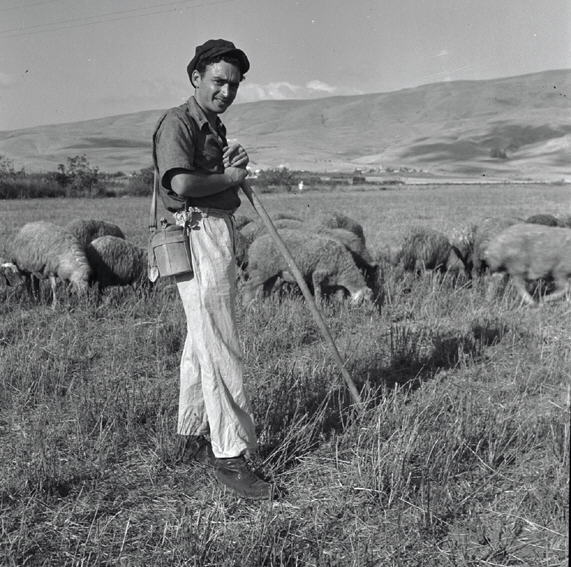
The shepherd stood by the gate. He was tall, thin, and young, with a sunburnt face. He had a strange wide-brimmed hat on his head, and a sack on his side. He held a long staff, turned like a poker, in his hand and with it he divided the flock into two. Half of the sheep to the left, and half to the right. He did it so skillfully and quickly, and with such a strange effortless calm, that it seemed to me as if he was a son and grandson of shepherds stretching all the way back to Father Jacob.
I asked Bela about him. She told me that the young man was a discharged soldier, the son of a kibbutznik. He had been an officer in the army. After his discharge, he returned to his sheep. He has been raising sheep for ten years, since he was thirteen years old. The young man is very talented. He will yet be heard from some day.
Strange thoughts crept into my head. How many of our fathers and mothers would have been content for their talented son to became a shepherd? And if he did achieve such a low status wouldn’t the rest of us have felt sorry for him.
Bela’s husband and my landsman Bertshik arrived on the last bus. An hour later we were seated on a bench in the shade near the water tower. A young man also sat with us, a garage mechanic with his lovely little boy. I listened while…
p. 151
they told me about the kibbutz economy and about dozens of little details. The garage-man said:
“In honor of our guests, let us all eat dinner together. We can sit around one table, and it will be festive.”
My landsman Bertshik answered him:
“You eat together. But I cannot eat with you. It’s my tor (turn) in the kitchen.”
I complained. “How is tht possible, Bertshik? I am a guest here. We have not seen each other for thirty-eight years. Who knows if we will get to see each other again in our lifetimes? And this very Shabbes you are on kitchen duty. And what kind of work is that anyway, for a manager who brings in so much money for the kibbutz? You languish in the city all week and when you come home on Shabbes to your wife and children, you still have to work in the kitchen, too?”
Bertshik smiled.
“I see you want to make a big shot out of me. We don’t have big shots here. Manager– shmanager. It’s a job like any other job. Everyone here does what they are capable of doing. Yes, it is true: If I had known a week ago that you would be coming to visit us, I would have arranged it so I would not be in the kitchen this Shabbes. I would have switched my turn to a week later. Now, it’s too late. No one wants to be in the kitchen on Shabbes. To put a someone else in my place who did not expect to work in the kitchen, and who likely planned to do something else, is not fair. If someone gets sick or in some other serious situations, so be it. It can’t be helped. But to do this only for the sake of my own pleasure is not nice.”
We ate the Friday night meal without Bertshik. To my surprise, the meal was quite meager. A simple meal like on any other night of the week. I was more than a little distressed. OK, if a kibbutz treats Shabbes like a weekday out of poverty, there’s nothing you can do. But to serve a Sabbath-like meal on Friday afternoon and then an ordinary meal on Friday night, that is really spiteful.
Overall, there was no hint of Shabbes in the dining hall, and throughout the kibbutz, Shabbes was tedious. People wandered around,..
p. 152
without a goal or purpose, with nothing to do with themselves the whole day. OK, to be honest, they did show a Russian film on Friday night.
Bella and her husband gave us their room and slept somewhere else. At four o’clock in the morning, there was a knock on the door:
“Bella, it’s past four. You’ll be late.”
I understood that they were calling my hostess to work, and answered.
“She isn’t sleeping here. She gave her room to us.”
The knocker excused himself and went away. I could not go back to sleep. What a strange little world it is here. The head of a factory languishes in the city all week and when he comes home on Shabbes, he has to do his share in the kitchen. The head of procurement for the kibbutz is also gone far from home all week. So he comes home to his wife on Shabbes, and she has to get up at four o’clock in the morning to work in the vineyard.
Our hostess got back from work around one in the afternoon. At four o’clock, she came to us in our room. It was teatime. But she would not go to the dining hall with us for tea. In honor of us, her guests, she would make tea and coffee here in the room. She had also invited her next-door neighbor to tea, along with the garage man.
She had brought two kinds of cake from the dining room, along with sugar, coffee and tea. We sat pleasantly on the veranda and talked: The garage man and his wife, who worked in the children’s house; the buyer for the kibbutz and his wife, who worked in the fields; and the neighbor, a professor of English, who had led special courses for a group of students in New York University, and his wife who is apparently a teacher in the kibbutz. The three families sat together and spoke about kibbutz matters. I sat and drank up every word. I have never seen such equality and true democracy.
In the middle of the conversation, Chaim remarked:
“Do you know who I saw in Kibbuts Sh-M? Boruch Cohn” (not his real name).
“What was he doing there?” the professor asked, clearly alarmed.
p. 153
“He is not a member of the kibbutz,” Chaim answered. “He is just working there. When he noticed me, he looked like he had seen a ghost. First, he turned red as a beet, then white as chalk. Evidently, he was shocked. I looked into it and found out that he only works there. So, you don’t take food out of someone’s mouth, even an unpleasant character like that.”
I was curious, and began to ask what they were talking about. Chaim told me.
“This man was in our kibbutz for a year. We began to notice that members were missing things. We looked into it, and suspicion fell on him. We chose two comrades to look into the matter further. When he was in the field, they went into his room and they found a lot of stolen things. They took everything they found and laid it out on his table and on the floor. They left the clothes closet open, and they did not close the door to his room. When he got back to his room from work, he understood that his secret was found out, and he quickly packed his suitcase and left the kibbutz.”
Since we were on the subject, we continued to discuss stealing in the kibbutz.
“No, such cases are rare. When they do happen, the kibbutz does not conduct a trial. The thieves are allowed to go, but they cannot be kibbutzniks any more.”
One more episode about the kibbutz in the Jordan Valley is worth telling:
Chaim took us to dinner at a nearby kibbutz, no more than four or five kilometers from his. Our driver was the garage man. He hitched up horse and wagon, and drove us over. He himself went right back to the kibbutz, because he had to get his trucks back on the road after sunset.
The kibbutz A.-Y. was one of the old kibbutzim. It lies on the Syrian border. The whole kibbutz is one lush park. A large group took us around to show us the kibbutz economy. All of them knew Chaim. He had been a member of A.-Y. for more than fifteen years. When he got married, he went over to his wife’s kibbutz.
p. 154
We ate supper at our own separate table. Six of the old zealots sat around us, all of them with gray hair and wrinkles, with sunburnt faces and heavily calloused hands. We sat and prepared the salad. Everyone made their own salad themselves. They were made too slowly and deliberately. Carefully they skinned the cucumbers and threw the skins into the Kolboynik. When they had cut the cucumbers into thin slices, they turned to the green peppers, cutting them open, taking out the seeds, shaking every piece of pepper over the kolboynik and then cutting the pepper into long ribbons. Done with the peppers, they would select tomatoes, looking each one over carefully. They would cut out the rotten “eyes”, if there were any, and then they quartered each tomato. The greens were mixed with a spoon and salted. Then, they carefully poured on a little bit of vinegar, and a fair amount of shemen oil. The salad was tasted with the tip of the tongue, to see if it was right. If not, more vinegar, more oil, or more salt, until it was they way they wanted it.
So sat the old die-hards, making their salads and talking.
“There’s a lot to deal with at our kibbutz,” said Chaim. “There is a large opposition there to our wood factory. A lot of our old-timers argue that we are no longer real kibbutzniks, because the farm suffers on account of our factory. The worst thing is, we do not have enough workers and we have to hire outside workers from the city. Now, eating and sleeping has become an issue. Since we are far from the city, so the workers have to eat and sleep at the kibbutz. So we charge them for eating and sleeping. A lot of the comrades complain: ‘Since when does a kibbutz charge for eating and sleeping?’ But that is nonsense! To not account for the meals of occasional guests is one thing. Feeding seventy workers day in and day out is another thing.”
“It’s the same thing here with us,” answered a friend. It has to do with hiring outside workers. Moreover, we want to enlarge our riba, our jam factory. We cannot manage without hiring outside workers. But (others complain), ‘If so, do we really need a jam factory?’”
A third man spoke:
p. 155
“There’s a fine mess! Give up a factory! And what if there’s a bad year in the fields? What if the prices for fruits and vegetables, or milk and eggs fall? No kibbutz can exist without a mixed economy. They have already forgotten the early years of poverty and need.”
“But it’s exploitation, nonetheless!”
“Who is exploiting whom? Who is pocketing the profits?”
“We are all taking it. Collectively, we live better.”
“The same arguments we hear at our place,” said Chaim.
One of the old-timers had put down his spoon and began talking fervently, emphasizing his words with his hands.
“So, good. I agree. Not everything here is according to the Shulkhn Orekh.[3] But I ask you, comrades, have we refused to admit the workers into the kibbutz? We want to, but they do not want to. So, what are we supposed to do? Give up the kibbutz? Should we be like the Luddite machine breakers who wanted to stop the industrialization of the world? There has to be a way out of this tangle!”
“By all means, let us hear it!”
“Wise guy. If I knew the way out, would I keep it a secret? I only know that the way out is not giving up the factory. To keep on having hired workers is also not good. The complication regarding how much to charge for meals is a truly unpleasant matter. But we are not the only kibbutz to be caught in a bind. It will have to be discussed and decided at the party conference.”
“A fine thing it would be,” joked one of them, “if a strike broke out on a kibbutz.”
Everyone laughed.
“Oh, what a fine time that would be!”
“You laugh,” a comrade said, bitterly. “Fie on your laughter.”
“So, cry then! My conscience is clean. I live in no better a room than our hired workers do. I have just as much money in the bank as I had before the factory opened, and I’m no better dressed. What more do you want?”
p. 156
“OK, that’s enough,” said Chaim. “We are not going solve all our problems today.”
The conversation switched to the price of wine grapes in the Jerusalem market, and how many tomatoes and cucumbers the kibbutz produced this year. Whether it was more than last year or fewer.
On the way back I was driven by truck. I left that kibbutz in the morning, and we arrived in another kibbutz in the Galilee late in the afternoon.
——————-
The kibbutz in the Galilee is almost exclusively an American kibbutz. There are also some young people from England and from Africa – all from among the English-speaking demographic.
As soon as we arrived at the kibbutz, my daughter and I went with one of their members to see the Jordan River, which cut through the kibbutz.
I walked up to it and saw a little river with high banks, just like a deeply dug-out canal. A stream of yellow-green water flowed quickly and forcefully. I took off my shoes, waded into the water, and stood there for a good long while. Then I sat down on a stone with my feet in the water, letting the river flow between my legs. I was so engrossed, I had not even noticed that my daughter had also taken off her shoes and sat down next to me with her feet in the water, too.
My companion told me.
“Now, in the summertime, the Jordan looks like a little riverlet with a narrow stream. You ought to see it during the rainy season! It fills up over its banks, high as they are. You think the Jordan is something to play with?”
Where had I heard that before? Ah, yes. In Joshua it is written: The Jordan is full over all its banks in all the days of harvest time. And soon another verse came up into my memory, a verse that at first did not have any connection with my thoughts:
And I walked across the Jordan with my walking stick, and now I am become two camps. From this Rashi interprets: “I did not have any silver, any gold, or any livestock, only my stick itself, and now I have become two camps.”
p. 157
Here we were, my little girl and I, sitting on the banks of the Jordan with its waters rinsing our feet. How many times had Jews crossed the Jordan to go into foreign lands, and returned? An individual received an order to settle in Canaan. He obeyed. His family increased and seventy souls went voluntarily into exile – into Egypt. There they stayed for four hundred years, and they came back as a people, back to their promised land. They got the land and lived there for over six hundred years and then were driven out. Returned a couple of generations later, strengthened in their belief in their chosen-ness. Originally, they came into the country with Aramaic and left with Hebrew. Then driven from the land as Hebrew speakers with the destruction of the first Temple, they returned with two tongues – Hebrew and Aramaic. Driven out a second time, and people were again bilingual, and the intelligentsia, trilingual. Now, nineteen hundred years later, the people has returned again. On the banks of the Jordan, there is once again a Jewish settlement where I hear three languages: Yiddish, English, and Hebrew. What kind of strength lies in this narrow body of water called the Jordan? What power lies in this remote bit of poor land, which still pulls this same people back?
“Yes, It fills up over its banks, high as they are. The Jordan is not something to play with!”
My acquaintances looked for me and found me sitting with my feet in the flowing current of the Jordan. They made fun of me:
“A Litvak should be so sentimental!”
As I live and breathe, they were right.
We were not at that kibbutz for long. The comfort and sanitary conditions were so poor, that we could not stay over there for more than one night. But I am very happy that we did not skip that kibbutz.
I spent that evening with a young Jewish man from Africa[4]. He had married the daughter of an acquaintance of mine. She was American born, a nursing school graduate, who went…
p. 158
to Israel before the war. She met this young Jewish man from Africa, who had served in a very important post in the army, and they married. They were only temporarily on the kibbutz. The young man had organized a new community out of a group that had received their preparatory training from the American kibbutz here. This group would be leaving this kibbutz before Rosh Hashone. They already had the land. They are planning a Moshav, a worker’s cooperative, but at first the Moshav will be organized as a kibbutz, because it is more economical.
I sat and talked with the young man until very late into the night. He knew little Hebrew and practically no Yiddish at all, so we spoke English. He knew very little about Judaism even now. He comes from a very wealthy family, has completed university, and has never done any physical labor. He is tall, good-looking and energetic, and is an extremely good organizer. I really wanted to get to the bottom of why he had come to Israel and why he stayed in the country. He could just take his wife and live a much easier life in Cape Town.
Here is what I gleaned from his conversation.
His Jewishness has never caused him any unease. He came here in the time of the War of Independence, because after the World War, he could not find anything fitting to do with himself. Traveling to, and fighting for, Israel was a kind of whim, an adventure, a way out of his postwar restlessness. When he saw the land and the life in the land, he had no desire to return home. When he met Naomi and married her, he decided to stay here. He especially liked the pioneering spirit of the kibbutzim and the justice in how they were organized. It was a concrete realization of the misty, abstract ethical Judaism his father had always talked about. He liked the primitiveness, freedom and honesty of the life here in general.
That night it became clear to me that Zionist leaders could accomplish a lot with the American Jewish youth if they, the leaders, appealed to young American Jews to come to Israel in order to live a just and ethical life. As of now, they go on and on telling young American Jews to run away from America, because anti-Semitism is bad and is going to get worse. According to the…
p. 159
Zionist view, Jews are foreigners everywhere. But young American Jews do not feel themselves to be foreigners in America. They are a restless youth, who seek justice and righteousness. They strive for a better life, for a more idealistic life. Such a life can easily be found in the State of Israel. A truly large portion of Jewish youth would be influenced by propaganda that placed its emphasis on idealism.
We got up early to leave on the first bus. The dining room was already open. There we met the African young man and two young Jewish Brooklynites. I know their parents very well. They are very prosperous Jews. The young men were dressed like peasants, ready to head out to the field. The spoke to me in English:
“Tell them over there in East Flatbush that they should stop talking about Zionism and come here. Who needs them there? Here we can put every one of them to use, especially a couple of good plumbers and machinists. Say hi to our fathers.
We parted. I promised the young African man that I would visit his new kibbutz/moshav in three years at the longest. We rode back to Ra’Anana.
(click here to continue reading Chapter 15)
[1] The Jordan Valley. Here, the Northern part of the Jordan Valley and the area around [the West of] Lake Kinneret.
[2] Lake Kinneret. In English, also called The Sea of Galilee, and also Lake Tiberias.
[3] Shulkhn Orekh– A legal code, written in the sixteenth century and still consulted by orthodox and haredi Jews.
[4] In 1950, there were roughly 100,000 Jews living in South Africa.
 The Nation State and the Promised Land