
The Nation State and the Promised Land: An American Yiddish Writer in Israel, 1949, by Solomon Simon. English translation, 2024, by David R. Forman. All rights reserved.
Page numbers from Medines Yisroel un Erets Yisroel, 1950, Farlag Matones (NY), are included for those who wish to follow along with the original Yiddish, below.
To begin with the Introduction, click here.
The days I spent in Holon were the happiest and brightest days of the three months that I was in the State of Israel. Holon is a new town three quarters of an hour’s drive from Tel-Aviv. My childhood friend Beinush lived there. I had not seen him for thirty-eight years. I was a little bit frightened to meet him. I thought: It’s possible I will encounter an old man, preoccupied by his health problems and oblivious to the vibrant life around him.
But instead, I encountered my old friend Beinush, with his same sharp mind, his same booming laugh, good humor, and thirst for learning as long ago. Like all Jewish intellectuals in Israel, he had not read any Yiddish since he came to the Land of Israel, a minimum of twenty-five years. But the Jewish tongue was still alive in his mouth and in that of his wife, who is also an old friend of mine. Their older daughter, Achsah, spoke a decent Yiddish. Their boy, Dan, who was eight years younger than their daughter, could barely understand Yiddish. Their son-in-law, Zhome, a tall official in the foreign ministry, spoke Yiddish fluently, if with a fair number of Hebraisms.
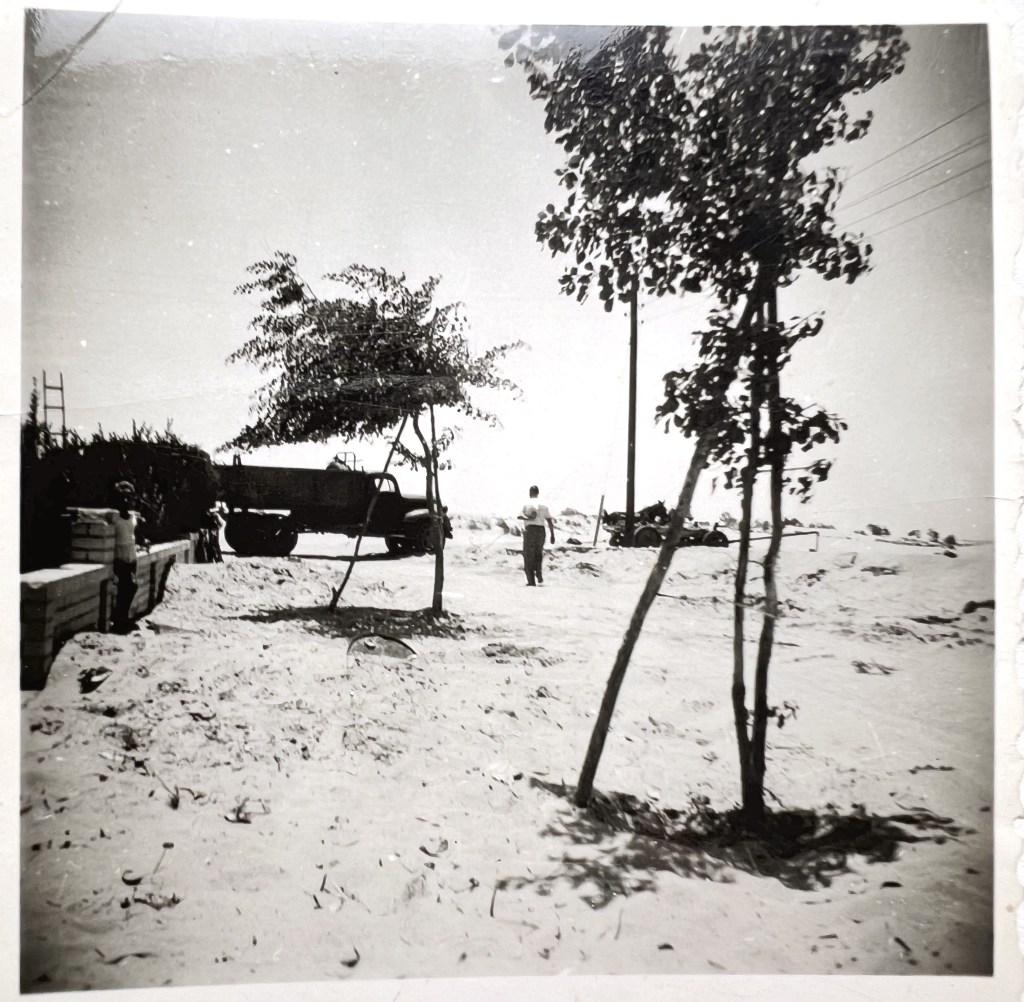
We would sit for hours and hours on the veranda, smoking, drinking tea and talking. The sands of Holon lay around us. Sand and more sand, as far as the eye could see. In the middle of the sand there was a narrow pass, paved…
p. 174
with asphalt, with charming, white, one-story houses built on both sides. Next to the bungalows were vegetable gardens, flowerbeds and shade trees. Beyond the fences was a deep, sandy desert. It was a true spiritual pleasure to spend time talking with the family. They had a thorough knowledge Jewish life in Israel, so they were well-oriented to all my questions. They were passionate Zionists, who disavowed the exile. However, they understood me and accepted my doubts and my dipleasure. They did not deny a lot of my accusations or try to minimize the negatives. They were honest and understanding opponents, but they often considered my negatives to be positive developments.
“Why are you angry,” my friend Beinush good-naturedly answered me, “when we say: A people is being born?[1] Certainly, the Jews were a people before Europeans knew they were supposed to wear pants. But over the span of two thousand years we were an unnatural people, a people that satisfied itself with a minimum connection between its citizens and its national life. Now, after the founding of the State of Israel, we have become a normal people. In this category, only now is a people being born.
“No, we do not accept that today Jews can also be a people in goles. Once, when religion played a role, it could have been imagined. Now, when religion has stopped being the main factor in life, Jews cannot consider themselves a people outside of the State of Israel. Jewish life has stopped being creative in exile. By creative, I do not mean writing books or painting paintings. There is a deeper creativity: To stake your own kind of life. In America, which is now the fortress of Jewish life, Jewish culture, tradition, and customs, you have completely renounced the shtetl. Here, we have completely revived the shtetl once again. You live together with your [non-Jewish] neighbors, not just physically but also spiritually. Your whole Jewish life has become an add-on, a supplement. It’s not for nothing that you have supplemental schools. Your day-to-day life must be emptied out of Jewish content. Then, too, your communal life is bloodless and impoverished. If not for the State of Israel, you would not have anything to do.
“Why haven’t our kibbutzim and workers’ collectives influenced the Jews in America and in the rest of the world the way Hasidism influenced Jewish life? The answer may seem…
p. 175
terrible to you. There is no one to influence. Your life in goles is such that you want an easy Judaism, a Judaism that does not disturb the comfort of the individual. Simply put, the human material in goles is not suitable. The Jewish person has lost his Jewish self.
“You, like all Jews who live a secular life, ought to be in seventh heaven when you come to our Jewish towns here. Holon, Ra’Anana, Kfar Saba, Rehovot, Petah Tikva – these are the old shtetls, but rebuilt and spiritually renewed. Gone are the idlers, the strictures of Shabbes and the holidays. The young do not tear themselves free to live a foreign life, and the fear of the Goy is gone. The kheyder, the one-room schoolhouse, has been transformed into a modern school. No more whip and no more suffocating little rooms. That is what we dreamed of.
“It does not solve the question of Judaism, nor the Jewish Question?[2] For you in goles, it actually doesn’t. For us, though, it solves both questions. A people in its own land does not have to have a justification for its existence. And here we will also have no Judaism Question. Give up the idea that the Jews are a world people. Accept that our dispersal is a curse, and you will solve both questions. A part of the people will come to us, and the rest will disappear. Under normal conditions they will disappear spiritually and assimilate. If there is a tragedy, they will be annihilated.
“Of course, today the State of Israel is living off the financial support of the diaspora. The sudden disappearance of the diaspora would be a catastrophe for the Jewish community here. But it is not immanent. The slow decline of the diaspora helps us. You are spiritual, economic, and physical fertilizer for us (the word he used was zobel).
“Your complaints against Hebrew and especially against the Sephardic pronunciation are fully justified. This divides us from klal-Yisroyl [the unity of the whole Jewish people], from the Yiddish speaking portion and from those who understand Ashkenazi Hebrew. But, first of all, we do believe in the unity of the Jewish people. Second, we wish to intentionally distance ourselves from everything that smacks of goles. Third, the people has not wanted Yiddish and does not want to maintain it now either. And, finally, why haven’t you established a Yiddish-speaking generation in America, which is as stubbornly determined as we are with Hebrew here? If there were such a generation, we would have to take it into account. Now, though – remember! We old Jews are not going to be here for long.
p. 176
“It is a loss to the people to shrink ourselves onto a small Jewish piece of land? Agreed. And if Jewish life in goles was creative, gushing with Jewish life, your complaint would make sense. But you in goles are declining. We believe that your supplemental Judaism is of little value now, and will be of less and less value. You are still feeding off the shtetl. You are still living on scraps. Your children, who are already fairly emptied out, will soon not even have any scraps. We will save what can be saved. It’s a little bit funny when a beggar acts like a big shot. You, when you talk about Jewish continuity, are in that category.”
My friend Beinush is a math teacher and, even in the summer, he is busy in the afternoons, giving private lessons. The students come to him every hour and a half. I found both his attire and his whole demeanor during these lessons odd. He would dress just in “khaki” shorts and an undershirt, and go barefoot. It shocked me. But that is the custom there, and no one looks askance at such details. The windows are always open there. I would sit on the porch and listen to the lessons. His voice is loud, and his explanations are very clear. He was always enthusiastic. I would watch him through the open window. He seldom sat, but would constantly walk around the room, explaining the hardest geometry problems and even trigonometry by heart in a fast, clear Hebrew. At first, it was hard for me to follow the Hebrew. Once I got used to it, I was often captivated by his wonderful explanations.
His son-in-law knew that his father-in-law was busy in the afternoons and, for my benefit, would come home earlier than usual from the foreign ministry. He and his wife had come to the Land of Israel very young. They both considered themselves to be Sabras. They were in the Palmach for years.
Both were exceptionally well-informed concerning the course of the recent war. An uncle of theirs, my friend’s wife’s brother, was one of the most important military leaders. When I left the shtetl, he had been a ten- or eleven-year-old boy. He came to Israel when he was twenty. He became a kibbutznik, and took an interest in military problems. I gather from…
p. 177
several sources that he had been the “brains” of the strategic staff. He was killed by chance during the last days of the war. Even though he was not famous among the general public, the newspapers were full of the news of his death. I read a lot about him at the time, but I never connected the deceased Mr. Glouberman with Shloyme the Menaker’s[3] youngest son. Zhome, my friend’s son-in-law, was Glouberman’s right hand. Achsah, Zhome’s wife, also had military experience.
In the afternoons, we would often lie on the grass as a trio, smoking and talking. I was surprised that such young people, who had been in the army for so many years, had enough time to read and study, and to be so well informed.
They were just as extreme Zionists as my friend Beinush. But he, at least, had still known the goles. They did not know any other life outside of the Land of Israel. Therefore, they spoke in less abstract terms. They disputed my arguments with their experiences, not with theoretical arguments.
The young man spoke with a strange calm:
“I understand you very well. You look at us Jews differently than we see ourselves here. You see Jews as a world people, spread across the four corners of the world (b’arba kanfot ha’aretz), and for you Israel is – another Jewish community. You complain to us that we have renounced the established Jewish way of abstract justice. But forget the abstract Jewish People for now. Imagine that you are not in America, where you live peacefully and neither your life nor the lives of your family are in danger. Imagine that you are here as I was eight or ten years ago and you are working with my uncle in a secret room. The room must be secret, because we are surrounded by two enemies: The old long-settled population and an imperial power that rules the country.
“We know that it will come to a decisive war. We are preparing ourselves. First we began to map out the country. We made a topographic map of every little corner, of every little hill, valley, and stone and everything was recorded. Every Arab village was researched down to the smallest detail.
p. 178
“We began to calculate: For the roads to our settlements to be secured, we have to take this and that village, we must have control over these and those hills. These roads must be in our hands. We had few weapons and less ammunition. There were not enough people. So we had to figure out what we could do with what we had.
“My uncle calculated every move, every movement, every future battle. We could take this village or that one with twenty-five people. For that one, twenty will be enough. This hill can be held by fifty people.
“We young ones used to haggle with him: We need to have fifty more men. If not… I remember how my uncle would answer us with a bitter smile:
“Correct. You are correct. We would lose a lot fewer casualties if we had another ten thousand young people and artillery and heavy machine-guns. It would be even better if we had an air force. But we do not have all these things. So for this bit of work I listed here, we can spare no more than twenty-two people.
“We worked out dozens of plans, and every plan had three alternative plans. When war broke out with the Arabs, we used my uncles plans, often without any alterations. When we sent a group of boys and girls in to take a village or a hill, we said:
“You are twenty in number. Here, this is your ammunition. You need to take this or that village. You need to take this or that hill. And they knew what that meant: Don’t return empty handed. Accept that not everyone will come back. They went. They took it. A lot of them did not return. Often a whole group was lost.
“So, you complain that it is not right to conquer a country by force. You complain that, from the first, we came here intending to become the majority in the country, and that means by conquest if necessary. OK, let’s say you are right. And what should we have said to the Arabs during the…
p. 179
war: Go ahead and drive us into the ocean? Come and cut us into pieces?
“Your complaints about Yiddish are complaints for my father-in-law. We have enough problems here without two languages. Starting Yiddish schools here is just what we need. We already have four or five kinds of schools as it is. Everyone has schools – the orthodox, the ordinary Zionists, the Mapai and the Mapam. We have no national public school system, but at least all our schools are in the same language. Now if we just found some Yiddish schools, our joy will be complete.
“The Arab question. If we accepted the concept of justice in the abstract and invited them back in, then there would truly be chaos. Their k’romim [vineyards] have withered, and their orchards, after a year without watering, are worthless. Some of their houses are occupied and the rest are ruined. It is a lot easier to settle the Arabs among the Arab nations, than to settle them among us.
“Do not be angry at me if I speak too sharply. But you have seen what a hard life we live here. If you in America lived as hard a life as we do here, you would easily be able to remake your own lives as we have done here. But you do not have the strength to do it. You have only enough strength to give money. You see the abyss of assimilation and you want us to save you. For the Yiddishists we are supposed to revive Yiddish, for the orthodox, renew orthodoxy, for the ethicists, uphold Jewish ethics. We have our own worries. We need to secure ourselves strategically with the wider population. We need to strengthen our economy. We need to settle the land. We have it hard enough ourselves. We want to use your strength for us. It’s a question of who will use whom. I think we will win. First, we are better organized, and second, we are ready to sacrifice. You, in goles, are sentenced to be merely fertilizer for the State of Israel. There’s no help for it.”
We were lying on the grass, next to a flowering tree. Opposite us, through the bushes, you could see the empty stretch of deep sand. Piles of cut branches and small, uprooted trees were heaped right next to the paved road. Zyome gestured towards them.
“Look how busy we are. Take Holon, for example. A few short years ago, it was a wasteland here. Sand. Sand like on the shore of an ocean where…
p. 180
no human foot stepped for hundreds of years. We came and bought the wasteland for good money. The Arabs shrugged their shoulders: The Jews have gone crazy. But we knew what we were doing. We wanted a large territory for suburbs near Tel-Aviv. Here on the sand, we built two suburbs: Holon A, and Holon B, and we made a whole amusement park near the beach. Before the war, the sands were an ideal place to test our homemade weapons.
But it is never an easy matter to build in the Land of Israel. After being here for a couple of years, we came to understand that sand is not so easy to tame. Our little gardens, our trees and our houses were getting damaged by the sand. Then we began planting parks. But we learned that it is not easy to plant parks on sand. You plant those trees and before they can grow, they are damaged. So we learned that we needed to bury thick, dead branches next to the young trees, in order to protect them. This costs money and takes time. We don’t have money to spare, and the time is needed for hundreds of other things. But we must have suburbs of Tel-Aviv. Do you understand?
That night we sat on the veranda. After dinner, the young couple and their boy went off to see a film. The three of us old people stayed, sitting and chatting. We talked about bygone years:
“Remember, Shloyme, that summer afternoon in the woods, deep in Dubnik, when we made a hut out of branches and lay there the whole day? That afternoon, we learned Meyse Midber,[4] by Chaim Nachman Bialik, by heart.”
I remembered, and for fun I began reciting. I recited three or four lines and then broke off. Beinush picked up and went further, but he, too, stopped after a few lines. A young voice from the neighboring house began quoting the next lines. We listed for a while. Then Beinush called out:
“Hey, Zevulin, you are tricking us! You are reading from a book!”
The young man came out onto his veranda, which was six feet away from ours, and said, earnestly:
p. 181
“I know the whole thing by heart. Do you want to hear it?”
“OK, I believe you.”
“But the American,” the boy pointed to me, “quoted the poem like a foreigner, like a goy who has studied Hebrew.”
Beinush laughed.
“Fool. When a goy learns Hebrew, he learns the right pronunciation. But a Jew who knows Hebrew from birth does not talk like a Sabra.”
The boy’s words interrupted our happiness. It was a beautiful moonlit night. To the left of us were the dead branches, buried in the sand next to the young trees, looking like tall clumps of grass. To the right was an ocean of sand, naked without a speck, shining its emptiness into the night.
Beinush spoke quietly, which was very unusual for him:
“I know that it’s very hard here for you. You don’t have it so good. Here you have come to Yidn-land, and you do not feel like you are at home. People treat you like a foreigner. You, who are so deeply rooted in Jewish life are called: Goles-Yid, American Jew with a bad Hebrew accent. People are constantly threatening you with a Hitler. But you yourself have said that the State of Israel is a rupture in Jewish history. You see different Jews here than you are used to seeing. Jews rooted in their own country, Jews who hold a rifle in their hands. Jews who do not rely on mercy; not on the mercy of the nations, not on the mercy of history, and not on the mercy of God, but on themselves. Believe me, we too are often uncomfortable with a lot of things. But since when has an old Jew been completely satisfied?
“Yes, a people is being born! It’s a little bit odd, even uncomfortable, to say about us Jews. But it’s true nevertheless. A completely new and different Jewish people will emerge. A lot depends on you and those like you in goles. If you succeed there in drawing the thread of old Yiddishkayt farther forward, and if the goyim do not become worse evildoers than they are now, then the young, new Jewish people will not be so proud, so full of chutzpah, and so different. But if you do not succeed – and I, as an old…
p. 182
Zionist, believe you will not succeed in altering the goles – then I say to you: Make peace with your fate. Do not yell. It will not help you. Shh. Be quiet. A new people is being born!”
I stood up, put my hand on his shoulder and said:
“You know, Beinush, when you were young, you wrote poetry. In your old age you became a mathematician. But you still have the vitality of a poet in you.”
The young group came back from the movie. They saw how we were sitting quietly and Zyome began to tease us.
“Well look how the old folk sit daydreaming. Probably remembering when they were young and had a full heads of hair.”
Our hostess served tea. Such were the days and nights that I spent in Holon.
[1] a ‘folk’.
[2] The “Jewish Question,” as it arose in political and social discussions and debates in Europe in the 18th and 19th centuries, is actually more than one question: As it was asked at the time, it meant, “What is the place of Jews in European society (in a historical period when Europe was experiencing new waves of nationalism)?” This in turn includes the questions: “How can Jews best achieve political emancipation?”, “Why is there so much anti-Semitism?”, and “How can it be eliminated?”
The “Judaism Question,” is the question of the continuity of Judaism in the modern world.
[3] Menaker. Person who removes prohibited veins from meat to make it kosher.
[4] Meyse Midber. “Metey Midbar” (The Dead in the Desert) in modern Hebrew. The long poem is based on a Talmudic legend of Hebrews freed from slavery in Egypt who died during the wandering in the desert. Not the fearful freed slaves who were depicted in the Torah, these were, in Bialik’s version, warriors who defied the God who would not let them proceed to take the Holy Land.

